The Nature Island: An Introduction to Dominica
In the vast, azure expanse of the Caribbean Sea, where the island arc typically offers a predictable cadence of white-sand beaches and turquoise lagoons, there exists a profound exception. Dominica does not cater to the conventional desire for gentle, manicured coastlines. Instead, it rises from the deep ocean floor as a rugged, emerald monument to the raw power of geological time. Known widely as the Nature Island, Dominica serves as a living laboratory for the primordial forces of volcanism and rainfall, standing apart from its neighbors as a bastion of untamed, mountainous wilderness.
To set foot on Dominica is to experience the Caribbean in its most primordial form. The topography is defined by sharp volcanic peaks that pierce the low-hanging clouds, creating a landscape of perpetual mist and sudden, spectacular waterfalls. This is not a country defined by the ocean alone, but by the verticality of its mountains, which act as a filter for the passing trade winds, drenching the island in enough rain to foster one of the densest and most verdant rainforests in the hemisphere. For the traveler or the scholar, understanding this nation requires shedding the expectations of a typical island holiday to embrace the complexity of a land where humanity exists in a respectful, sometimes humble, equilibrium with nature.
A Crucible of Culture and Conflict
The human story of Dominica is as turbulent and layered as its geological record. Before European contact, the island served as a fortress for the Kalinago people, who utilized the island's impenetrable interior to resist colonization for centuries after their neighbors had fallen. This history of defiance and cultural endurance is deeply embedded in the identity of the island today. To truly appreciate how the island became a nexus of Afro-Caribbean, European, and indigenous influences, one should explore the history of Dominica, which details the complex shifts from colonial rivalries to modern independence.
The passage of time on this island has been marked by dramatic turning points, from the fierce naval battles of the 18th century to the rise of an agrarian society rooted in the rugged volcanic soil. For those looking to sharpen their understanding of this timeline, we invite you to engage with our history puzzle, an interactive data challenge that tasks students with chronologically organizing these defining moments to earn their place in the GeoGnos archives.
Visualizing the Soul of the Island
Dominica offers a sensory experience that eludes simple textual description. The steam rising from the Boiling Lake, the dark, volcanic sands of the coastline, and the mist that clings to Morne Diablotin require a visual synthesis. We provide a curated look at the legacy of this land through our history cinematic showcase, where rare illustrations and primary accounts converge to bring the island’s past into vivid focus. This collection is intended as an educational supplement for both the classroom and the curious mind, bridging the gap between historical fact and atmospheric reality.
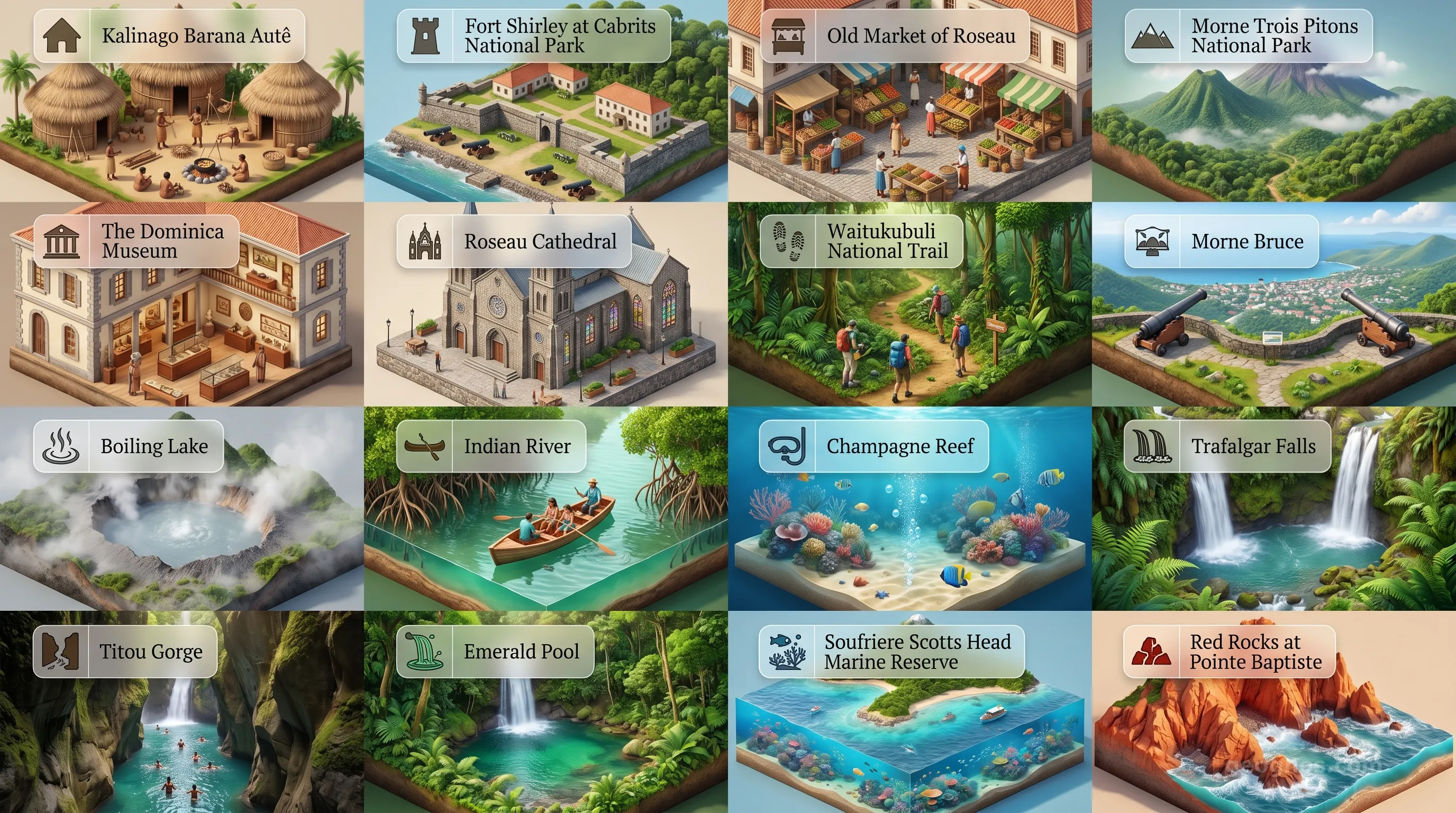
Beyond the pages of history, the island’s present landscape is populated by wonders that feel almost mythic. From the hidden emerald pools within the rainforest canopy to the coral reefs teeming with marine life just offshore, the beauty of the island is relentless. You can see these landscapes come alive through our POI cinematic showcase, which highlights the geography that makes Dominica a unique global destination for biologists, historians, and intrepid travelers alike.
Living with the Volcano
The geography of Dominica is fundamentally defined by its volcanic activity. Unlike many neighboring islands that have gone geologically silent, Dominica is a masterpiece of ongoing geothermal processes. The island possesses the second largest hot spring in the world, the Boiling Lake, a constant reminder that the earth beneath the feet of the local populace is very much alive. This, combined with the extreme drainage of the mountainous terrain, results in a hydrological wonder featuring 365 rivers, one for every day of the year, which carve deep, dramatic valleys through the interior.
For the student of Earth sciences, Dominica offers a masterclass in land-use and environmental resilience. The steep slopes have discouraged massive urban sprawl, leading instead to the preservation of primary forests. This geography has not only shaped the physical silhouette of the island but has also dictated the cultural trajectory of its people, fostering a community that prides itself on organic agriculture and ecotourism. It is a nation that has learned to thrive in the shadow of giants, using the volcanic minerals to enrich the soil and the mountains to protect their heritage.
A Legacy of Resilience
The enduring appeal of Dominica lies in its stubborn refusal to conform to globalized expectations of luxury. There is an intrinsic value here found in the clarity of its mountain streams, the density of its flora, and the warmth of a culture that holds firm to the traditions of its diverse ancestors. As a traveler or student, you are invited to look closer, to traverse the Waitukubuli National Trail, and to witness a landscape that remains one of the world's few surviving strongholds of true tropical wilderness. Dominica does not simply offer a map; it offers a dialogue between the observer and the primordial earth.
As we delve further into the specific metrics of the nation—ranging from its unique constitutional government to its efforts in renewable geothermal energy—we hope that the context provided here acts as a bridge. Dominica stands as a beacon for environmental sustainability in the modern age, proving that a country can leverage its natural identity to build a future that is as resilient as the mountains that sustain it.