The Land of Lakes and Volcanoes: An Introduction to Nicaragua
In the vast tapestry of the Americas, there exists a sliver of land that hums with an elemental energy found nowhere else. Nicaragua, the largest country in Central America, is defined not just by its borders between Honduras and Costa Rica, but by the colossal forces of nature that continue to sculpt its spirit. Here, geography is not merely a backdrop for human existence; it is a living, breathing participant in the narrative of the nation. From the immense, shimmering expanse of Lake Nicaragua—an inland sea harboring bull sharks and hundreds of volcanic islets—to the smoking, sentinels of the Pacific volcanic arc, Nicaragua is a realm of startling geological theater and profound human resilience.
To step into Nicaragua is to traverse a landscape shaped by upheaval and creativity. It is a place where the phrase "Land of Lakes and Volcanoes" serves as both a literal description and a poetic manifesto. For the student of geography, the nation offers a masterclass in tectonic drama, while for the traveler, it presents an authentic, unvarnished encounter with a culture that balances quiet humility with an extraordinary, fiery creative spark.
A Crucible of Cultural Evolution
The soul of Nicaragua is inextricably linked to its long, complex, and transformative narrative. This is a story defined by its geography as a strategic bridge between worlds. Before the colonial era, the territory served as a profound mixing ground for indigenous civilizations, with cultures originating from both the northern Mayan influence and the southern Chibchan peoples melding into a unique synthesis. As one explores the comprehensive history of Nicaragua, one finds that this land has always been a focal point for those seeking to understand the shifting tides of the Western Hemisphere.
Modern travelers and scholars alike find value in tracing these events, not just as a static academic exercise, but as a living inheritance that informs the vibrant present of the nation. To truly grasp the sequence of these pivotal moments, we invite users to engage with our interactive chronological puzzle of Nicaraguan history, where you can arrange significant eras and milestones to earn badges and deepen your comprehension of how this resilient country took its modern form. By visualizing the trajectory of the past, the present-day landscape of cities like Granada and León—where colonial architecture sits in the shadow of majestic cones—becomes infinitely more layered and meaningful.
Visualizing the Epic of the Land
How does one capture the grandeur of a land where craters bubble with molten earth and the dense jungles of the Caribbean coast meet the serene colonial piazzas of the interior? Language is a vital tool, but visual connection remains the most immediate path to understanding. Whether you are preparing a lecture on the environmental history of the tropics or planning an immersive journey, witnessing the transformation of this landscape is essential.
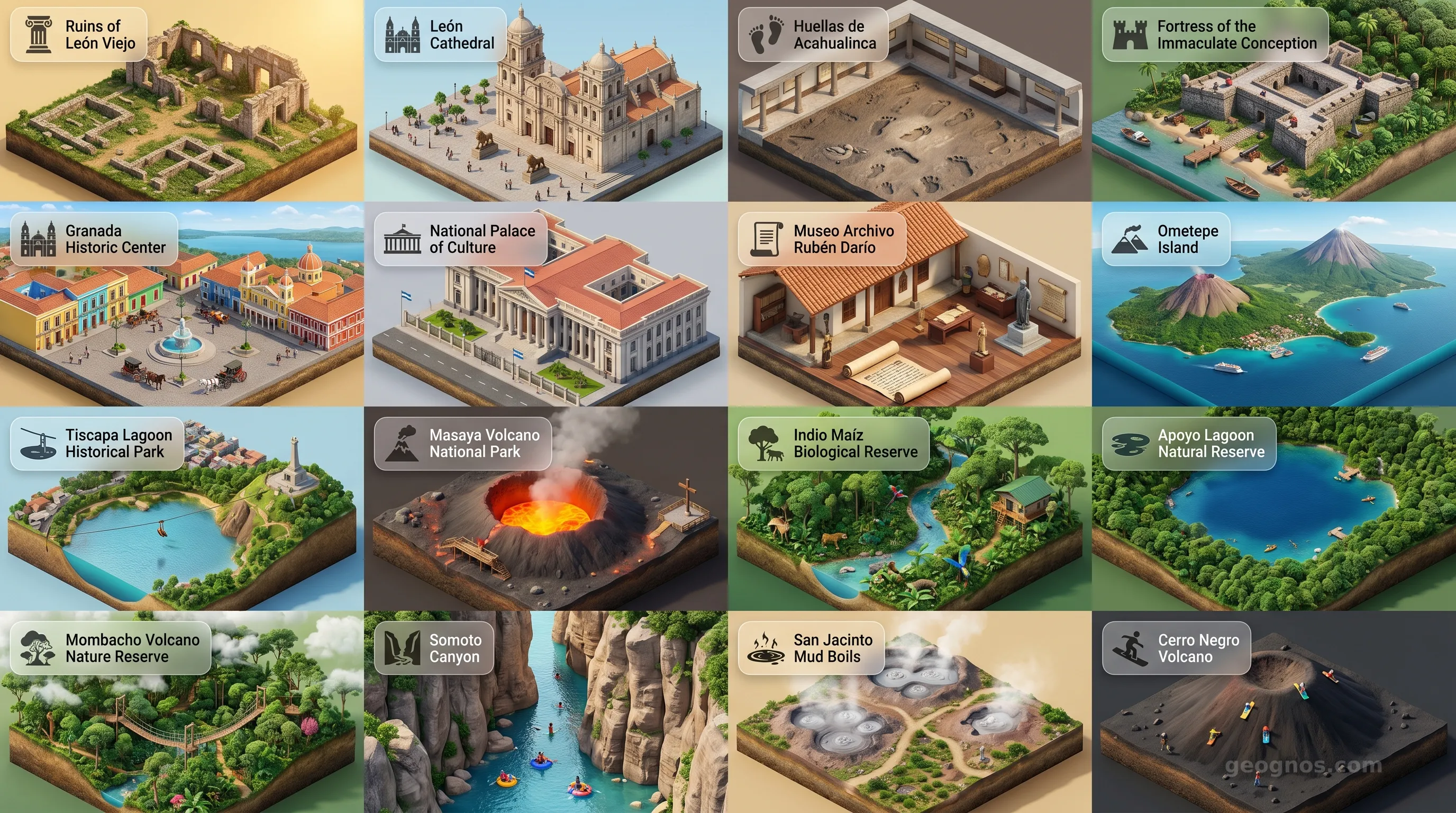
For a visceral look at the events that forged this nation, we provide a specialized cinematic showcase of Nicaragua's historical timeline. This curated experience pairs poignant illustrations with succinct summaries, offering a sweeping look at the cultural milestones that have defined the Nicaraguan identity. Beyond the scope of history, the physical beauty of the nation is captured in our comprehensive showcase of Nicaragua's premier points of interest, guiding your eyes from the architectural heritage of the cathedral rooftops in León to the wild, untouched shores of the Corn Islands.
The Ecological Tapestry
Nicaragua occupies a privileged position within the Central American corridor. Its geographical features create a dualistic experience. To the east, the Mosquitia region represents one of the largest tracts of primary rainforest in the Americas, a verdant lung that supports unparalleled biodiversity. To the west, the rift valley—the very depression that birthed the country's iconic lakes—provides the agricultural heartland and the home to the majority of the population. This north-south divide creates a microclimate complexity that supports everything from cloud forests in the northern highlands to the tropical heat of the Pacific beaches.
This biological richness is more than a resource. It is the defining feature of the Nicaraguan experience. Students of ecology often point to Nicaragua as a primary case study for the interplay between volcanic soils and high-yield tropical farming. Coffee, grown in the cool, elevated volcanic soil of Matagalpa, is not just a commodity, but a cornerstone of the national economy that sustains countless families and preserves the surrounding landscapes.
The People and the Promise
Yet, no account of Nicaragua would be complete without highlighting the spirit of its inhabitants. Known for a warmth that is often described as disarming, the Nicaraguan people are the custodians of a nation that remains delightfully undiscovered by mass tourism. Whether in the bustling, colorful markets of Managua, the poetic, tradition-bound streets of León, or the mist-covered mountain towns of the north, there is a consistent emphasis on community, artistic expression, and connection to the land.
As you delve further into the various modules of this atlas, from our 3d diorama maps to our in-depth sections on governmental and economic structures, remember that every data point, every demographic shift, and every geographic calculation is an invitation to engage. Nicaragua is a nation that asks its guests and students to look closer, to see past the surface of the news, and to recognize the profound stability of a land that has spent centuries turning fire and stone into a home of lasting character.