The Heart of the Continent: Paraguay's Enduring Rhythm
Paraguay is often whispered about as the "Island surrounded by land." Tucked deep into the geographic center of South America, this nation defies the standard blueprints of post-colonial development. While its neighbors often define themselves by their expansive coastlines or towering Andean ramparts, Paraguay thrives on a profound, quiet interiority. It is a country defined by the red earth, the vast wetlands of the Gran Chaco, and the life-giving pulse of the Paraguay and Paraná rivers, which have served as the country’s ancient veins of commerce and communication for millennia.
To understand Paraguay is to understand a resilience that is both fierce and deeply communal. It is a place where two languages—Spanish and the indigenous Guaraní—do not merely coexist but entwine, creating a cultural fabric that is distinctly Paraguayan. This is not a country that shouted its presence to the world, but one that cultivated an internal richness, waiting for the patient traveler to peel back the layers of its fascinating story. Whether you are an educator mapping the migration of peoples or a student discovering the geopolitical realities of South America, we invite you to begin by looking into the deep roots of this nation. We recommend you explore the comprehensive history of Paraguay, which chronicles how this unique cultural synthesis emerged over the centuries.
A Landscape of Extremes and Harmonious Coexistence
The geography of Paraguay is a study in binary contrasts. To the east of the Paraguay River lies a fertile, lush landscape of rolling hills and dense subtropical forests. This is the heart of the country’s population and agriculture, a verdant zone that feels almost rhythmic in its productivity. Shift your gaze to the west, however, and you enter the Gran Chaco. The Chaco is a sprawling, semi-arid lowland that captures the imagination with its scrub forests and vast savannas. It is a region of raw, untamed beauty that stands as one of the final great frontiers in South America.
These landscapes have dictated the flow of human settlement for centuries, compelling explorers, indigenous groups, and Jesuit missionaries to adapt to a life dictated by seasonal floods and vast distances. If you wish to test your knowledge of how these distinct regions influenced the unfolding of national identity, engage with our interactive history puzzle to see if you can chronologically order the events that built the nation we see today. Each successful placement reveals deeper layers of the country’s development, helping to anchor the physical landscape within its chronological evolution.
The Artistic Expression of Memory
Paraguay does not just record history; it performs it. The legacy of the Jesuit missions, the complexity of its colonial inheritance, and the subsequent modernization of its cities are best viewed through a lens that values artistic heritage. The artistic spirit of Paraguay is reflected in everything from the intricate needlework of the ñandutí lace to the complex harmonies of the Paraguayan harp. For those eager to witness these historical epochs in a visually immersive way, our history cinematic showcase provides a gallery of illustrations that capture the pivotal moments of this country's journey. It is a dynamic experience that translates abstract dates and events into a vibrant narrative of human endeavor.
As you traverse the nation through these archives, you will note how architecture, geography, and art remain inextricably linked. From the iconic red-brick ruins of the mission towns to the burgeoning, glass-fronted skyline of Asunción, the nation honors its past while sprinting toward a contemporary future. This forward-looking attitude is perhaps nowhere better represented than in the varied topography and natural wonders that define the landscape.
From Jesuit Ruins to Natural Wonder
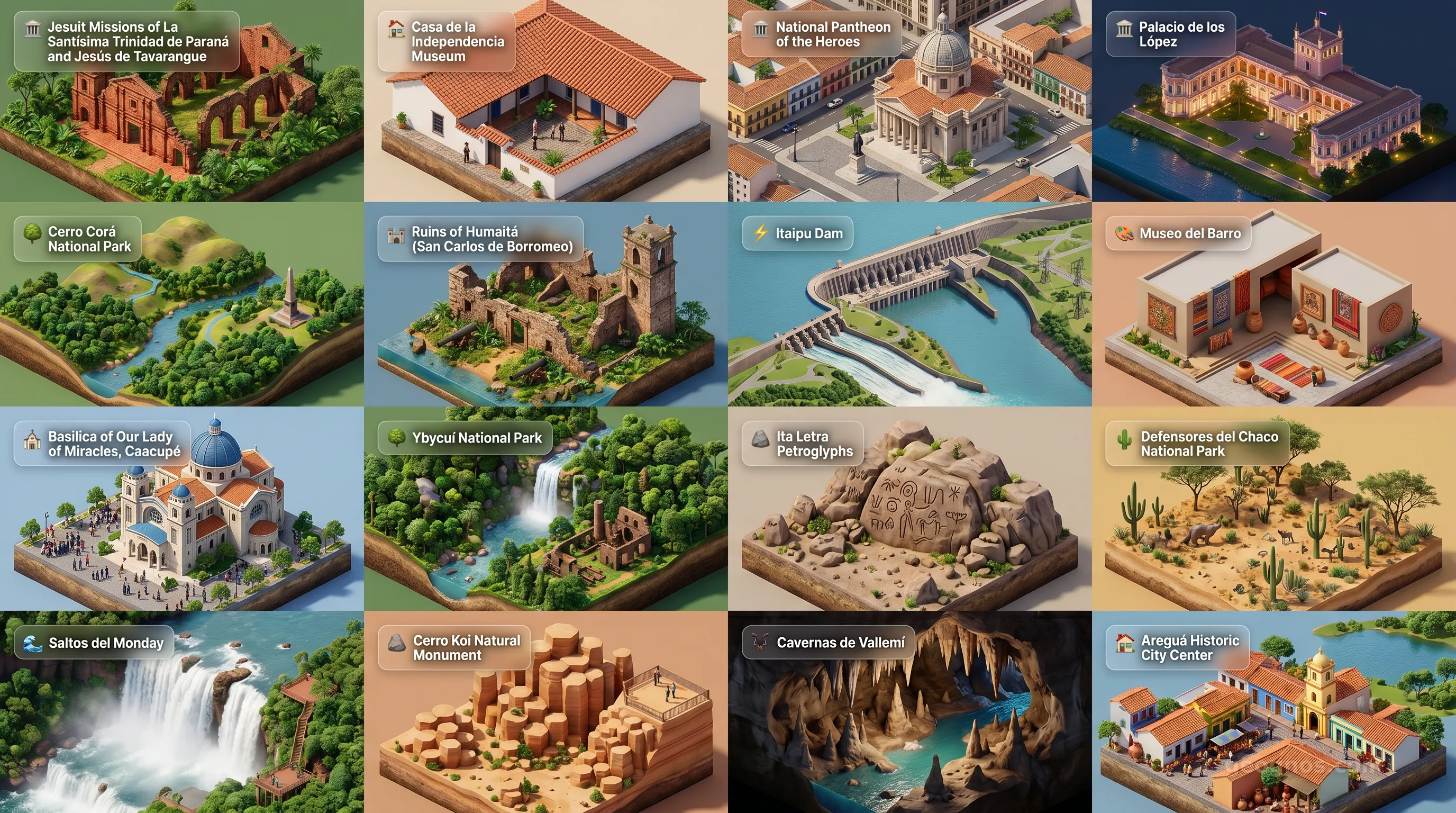
While the cultural narrative is compelling, the raw aesthetic appeal of Paraguay is best seen through its points of interest. It is a country of quiet corners and explosive spectacles, ranging from the thunderous cascades of its massive hydroelectric dams—testaments to modern engineering—to the serene, hidden waterfalls of the eastern departamentos. Paraguay offers a sanctuary for the curious mind and the contemplative soul.
We invite you to witness the diversity of the nation’s landscapes and historical sites through our POI cinematic showcase. This visual tour acts as a companion piece to the geographic data that follows in our atlas. It provides a deeper appreciation for why this nation, located at the beating heart of the southern hemisphere, remains such a vital piece of the global puzzle. By observing these images, students and travelers alike can bridge the gap between map coordinates and the tangible reality of the Paraguayan experience.
A Foundation for Future Exploration
The study of Paraguay is more than just an examination of borders and trade agreements. It is a lesson in cultural persistence. Even as the nation engages with the global market through its energy production and agriculture, it retains an atmosphere of intimacy and local warmth that is rare in the modern age. As we progress through this GeoGnos profile, remember that every data point, every population statistic, and every energy output number reflects the lives of the millions who call this "Island of the South" home.
Paraguay invites you to look beyond the surface of a simple map. It asks you to consider how a country thrives when it is defined by its relationships—with its rivers, with its heritage, and with its neighboring brothers and sisters. May this exploration be your gateway into the vibrant soul of Paraguay, a nation that has mastered the art of being both fundamentally indigenous and globally connected.