The Cradle of Civilization: An Eternal Narrative
To speak of Iraq is to speak of the very foundation of human narrative. Nestled within the fertile embrace of the Tigris and Euphrates rivers, this land serves as more than a geographical entity. It is the crucible where humanity first learned to codify law, chart the stars, and sow the seeds of settled life. For the traveler and the scholar alike, Iraq is not merely a destination but a return to the roots of collective human experience. Its identity is etched in the alluvial plains of the south and the rugged, verdant mountain ranges of the north, a landscape that has served as the stage for the greatest dramas of antiquity.
When we examine the timeline of human progress, we find that almost every fundamental innovation in organized society emerged from these soils. The Sumerians, Akkadians, Babylonians, and Assyrians were not just empires, but intellectual catalysts that gave us the wheel, the plow, and the written word. To truly grasp the gravity of this legacy, you are invited to explore the history of Iraq through our comprehensive History Essay, which traces the evolution of these civilizations from the first city-states to the golden ages of science and philosophy.
The Living Archive of Humanity
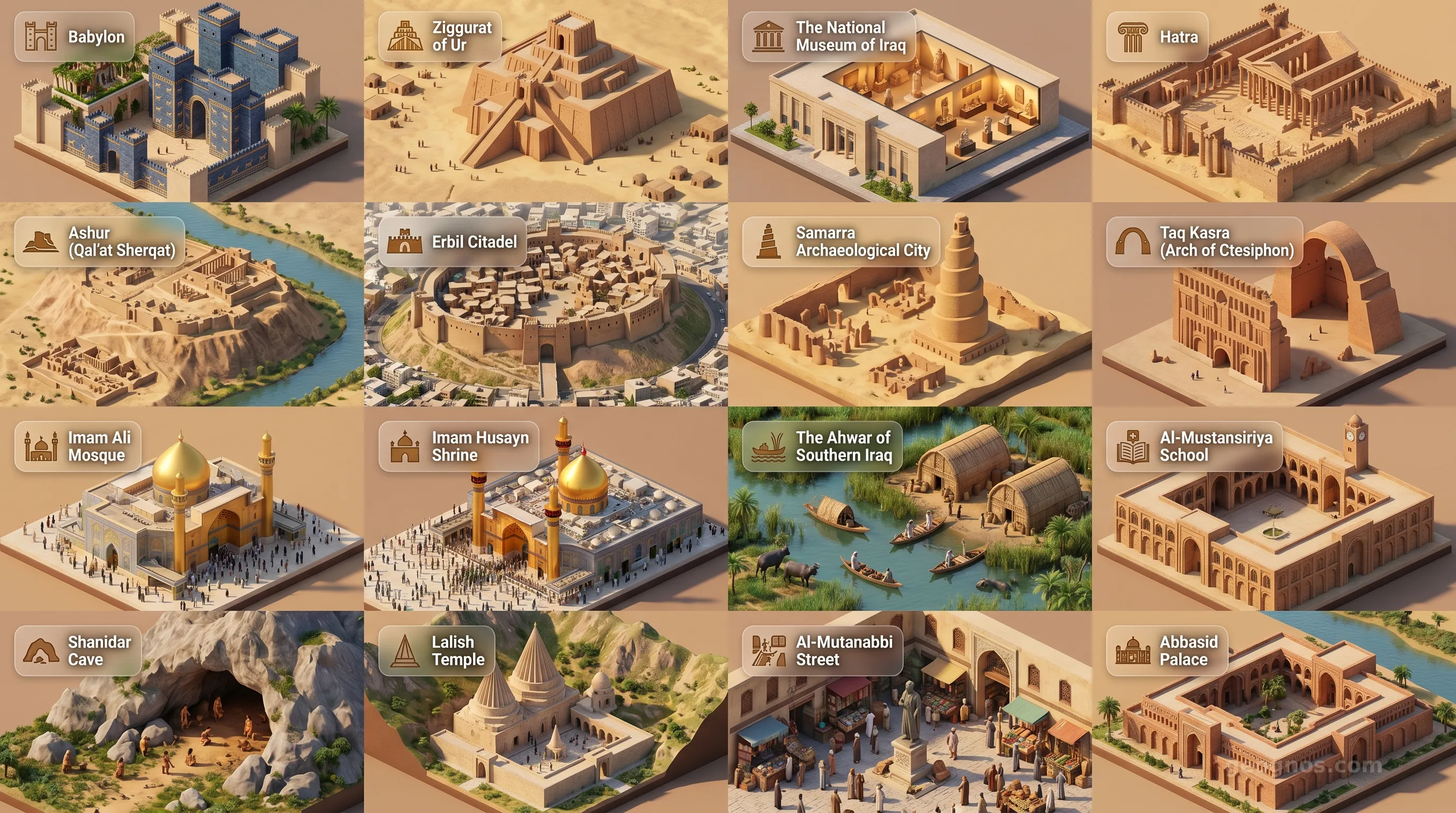
The spirit of Iraq is held within its architecture, its poetry, and the shifting sands that guard the ruins of once-great metropolises. Walking through the remains of Babylon or gazing upon the Ziggurat of Ur is a lesson in perspective. The country serves as an open-air classroom for anyone interested in how the environment directly informs cultural longevity. While the southern marshes hum with the rhythm of a traditional lifestyle that has survived for millennia, the metropolitan pulse of Baghdad stands as a testament to the intellectual centers that once acted as the light of the medieval world.
For those looking to engage with this vast historical tapestry in a tactile way, our History Puzzle provides an interactive challenge, allowing you to sequence major historical developments and earn badges as you master the chronology of one of the world's most enduring nations. It is a perfect tool for classrooms and history enthusiasts who wish to visualize the ebb and flow of regional power across the centuries.
Visualizing the Infinite Landscape
The geography of Iraq is defined by a dichotomy of contrasts. The vast, sun-drenched plains of the interior surrender to the jagged peaks of the Zagros Mountains, offering a topographical diversity that remains largely hidden from the global mainstream. These landscapes are more than just terrain, they are the silent witnesses to the emergence of early agriculture and the complex water management systems that allowed civilization to flourish in a semi-arid environment.
To help our readers better conceptualize these environments and the storied ruins scattered across them, we have curated a multimedia experience that brings the architecture and landscape to life. You can immerse yourself in the past by viewing our History Cinematic Showcase, which weaves together illustrations of defining historical moments into an evocative visual timeline. Similarly, to appreciate the breathtaking geography and modern structural landmarks of the country today, we recommend visiting our POI Cinematic Showcase, which guides you through the top points of interest in Iraq, ranging from ancient archaeological sites to the modern vibrancy of its cityscapes.
A Future Rooted in Ancient Soil
Today, Iraq occupies a unique space in the global community. It is a nation transitioning through a contemporary lens while holding the immense weight of its past. For the student, the educator, and the aspiring traveler, Iraq offers a wealth of discovery that transcends political headlines. It is a study of resilience and continuity. The preservation of these sites, combined with a youthful, ambitious demographic, signals a new era for the country, one where education and cultural exchange become the primary vehicles for understanding.
As you navigate this page and the accompanying resources, remember that you are stepping into a narrative that has shaped your own intellectual inheritance. From the birth of literacy to the expansion of astronomy and irrigation, Iraq remains a cornerstone of global education. Through GeoGnos, we encourage you to look beyond the modern borders and see the land for what it truly is: an enduring repository of human achievement and a landscape that continues to reveal its secrets to those who approach it with a keen mind and an open heart.