The Golden Threshold: A Portrait of Burma
There exists a land where time does not flow in a straight line but spirals like the golden stupas that crest the hillsides of the Irrawaddy Basin. Burma, known officially as Myanmar, is a nation defined by its verticality and its devotion. From the snow-capped Himalayan foothills of the far north to the emerald archipelagos of the Andaman Sea, this country serves as a grand theater where the terrestrial and the divine meet. It is a place of profound geographical contrasts, acting as a bridge between the Indian subcontinent and the bustling markets of East Asia, yet it remains anchored in a rhythm entirely its own.
To understand the soul of this nation, one must look to the rivers. The Irrawaddy is the lifeblood, a liquid highway that has nourished civilization for millennia, carrying silt to the plains and pilgrims to the sacred sites. As we peer into the origins of this fascinating region, we invite you to explore the history of Burma, a deep dive that chronicles how these alluvial plains birthed empires, fostered a distinct Buddhist identity, and navigated the complex shifts of regional power over the centuries.
The Geometry of Belief
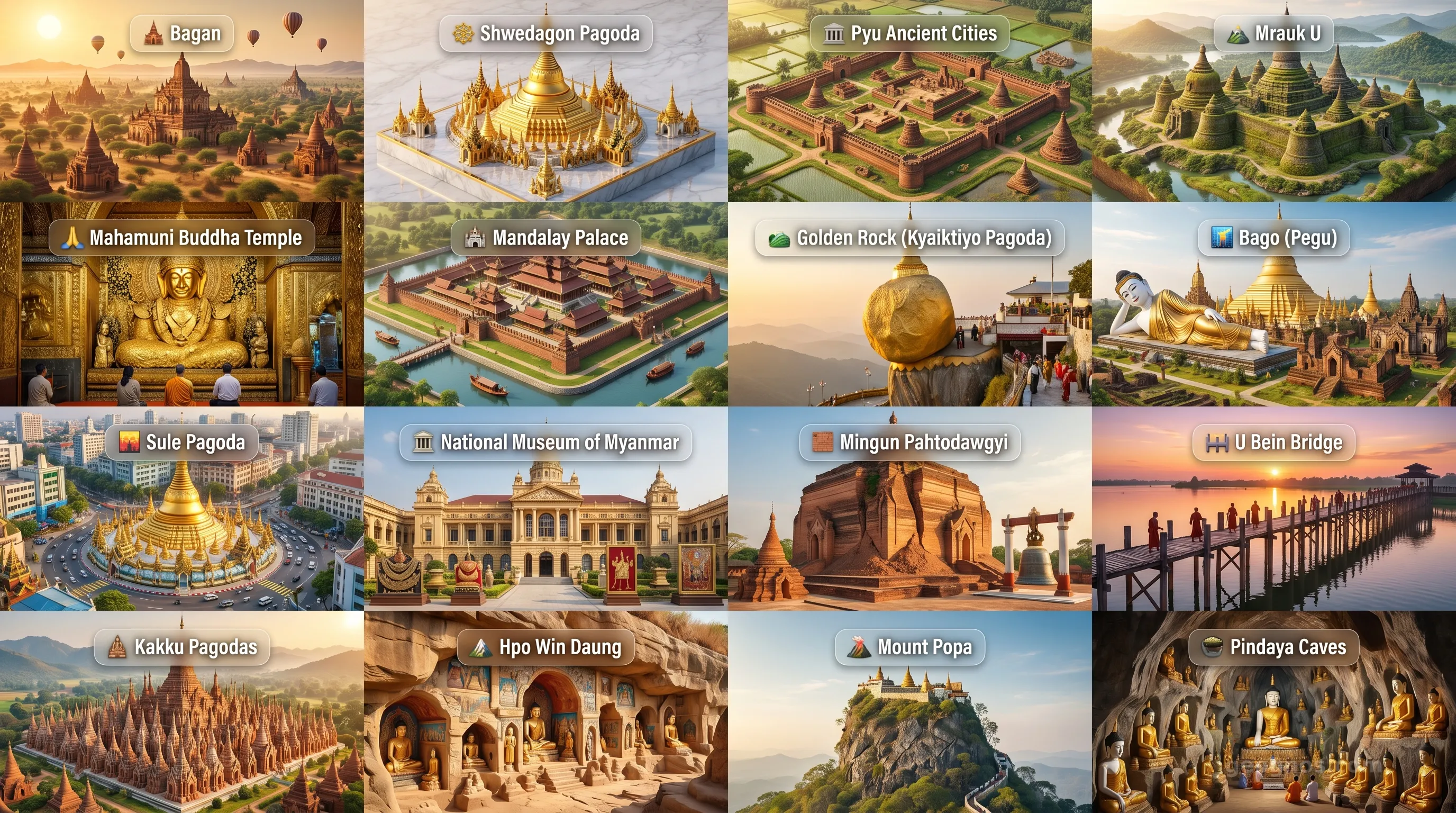
The cultural landscape of Burma is painted in hues of ochre, saffron, and weathered teak. In the heartland of Bagan, thousands of temples rise from the dust like geological outcroppings, a testament to the sheer architectural ambition of early dynasties. Here, the geography shaped a specific kind of faith, one where the act of merit-making through construction allowed the human spirit to reach toward the heavens. For those who wish to visualize these transformations in a way that transcends static text, our History Cinematic Showcase offers a window into these bygone eras, bringing the visual splendor of Burma’s evolution to life through curated illustrations and expert summaries.
The transition from the ancient kingdoms to the modern identity of the Burmese people is a lesson in resilience and continuity. The nation functions as a crossroads of civilizations, where Mon, Bamar, Shan, Karen, and Chin cultures interweave to create a rich tapestry of linguistic and artistic traditions. If you feel ready to test your grasp of this complex narrative, we encourage you to challenge your wits with our History Puzzle. By placing key moments in their correct chronological sequence, you can sharpen your understanding of the major events that shaped the borders and cultural benchmarks of this enigmatic land.
Topography of the Extraordinary
Burma is, at its essence, a land of topographical extremes. To the west, the rugged Chin Hills and the Rakhine Yoma act as a formidable barrier, keeping the monsoon rains balanced against the interior plains. To the east, the Shan Plateau offers a temperate escape, a mountainous highland where tea plantations cling to the terraced slopes. Down south, the landscape softens into the sprawling delta region, a swampy, life-sustaining mosaic of mangroves and paddies that produces the rice necessary to sustain millions.
Travelers who venture here often find their perceptions of space and time altered. Whether it is the reflection of the sunset on Inle Lake where fishermen row with their legs or the mist clinging to the pagodas of Sagaing, the country possesses a unique, enduring charm. We invite you to lose yourself in the breathtaking diversity of the nation by browsing our POI Cinematic Showcase. This visual journey captures the majesty of the landscapes and the human heritage found in every corner of the territory.
A Heritage Rooted in Earth and Water
The spirit of Burma is quiet yet indomitable. It is found in the communal act of daily prayer, in the vibrant color of local marketplaces, and in the sheer ingenuity of communities adapting to an environment that ranges from high alpine wilderness to tropical coastlines. As an educational entity, GeoGnos strives to provide more than just facts; we aim to foster an appreciation for the symbiotic relationship between people and their geography.
The stability of the nation has always rested on the health of its lands. As scholars and students observe, the interplay between the vast water systems and the mountainous interior creates a climatic diversity rarely seen in a single sovereign state. From the dry zone where cactus and acacia thrive to the lush rainforests of the Tanintharyi Region, the biodiversity is a silent treasure. We hope this introductory exploration serves as the first step in your broader investigation into this resilient, ancient, and endlessly beautiful part of our world. As you proceed to study the governance, environment, and economy of this country, remember that every policy and every statistic is inextricably linked to the physical earth upon which the Burmese civilization has built its home.