The Green Cathedral: Suriname’s Unbroken Canopy
There is a place on the northeastern shoulder of South America where the heavy, humid breath of the Atlantic meets the dense, ancient lungs of the Amazon basin. It is a nation that defies the easy labels often pinned to the continent. Suriname is not defined by mountain peaks or bustling urban megalopolises, but by a sprawling, verdant silence that hums with the pulse of life. It is, perhaps, the most overlooked jewel of the Guiana Shield, a land where rivers serve as the primary veins of civilization and where the horizon is consistently dominated by the emerald embrace of the world’s most significant rainforest.
To understand Suriname is to accept the paradox of being both deeply rooted and incredibly fluid. It is a nation forged from the confluence of vastly different human journeys, an intentional cultural crossroads where the mosques of Paramaribo stand in literal neighborly harmony with synagogues and wooden cathedrals. Yet, this human tapestry exists within a landscape that remains stubbornly wild. If you wish to ground your understanding of how this unique society emerged from its colonial roots and ethnic convergence, you must first explore the history of Suriname. Here, you will find a record of how disparate migrations shaped the social fabric we see today.
The Living Mosaic: A Geography of Cultural Symbiosis
Suriname’s demographics are a masterclass in global integration. Within its borders, the descendants of Dutch colonists, enslaved Africans, indentured laborers from India and Indonesia, and indigenous peoples like the Trio, Wayana, and Kalina interact with a quiet, mutual respect. This is not a society of segregated enclaves, but rather a community that has curated a singular Surinamese identity that celebrates its plurality. Whether it is the rhythmic percussion of Kaseko music or the lingering aromatic spices in a local Javanese-inspired market, the culture of the nation is a sensory testament to endurance and creativity.
The geography dictates this rhythm. Because over 90 percent of the nation is covered by tropical forest, human settlement is hugged tightly against the northern coast. The inland areas remain largely the domain of the Maroons—descendants of Africans who carved out autonomous, traditional societies centuries ago—and the original indigenous nations. To grasp how these distinct threads were woven across the centuries, students can engage with the history puzzle, an interactive chronology that brings the timeline of the nation to life through rewarding educational gameplay.
Guardians of the Wild
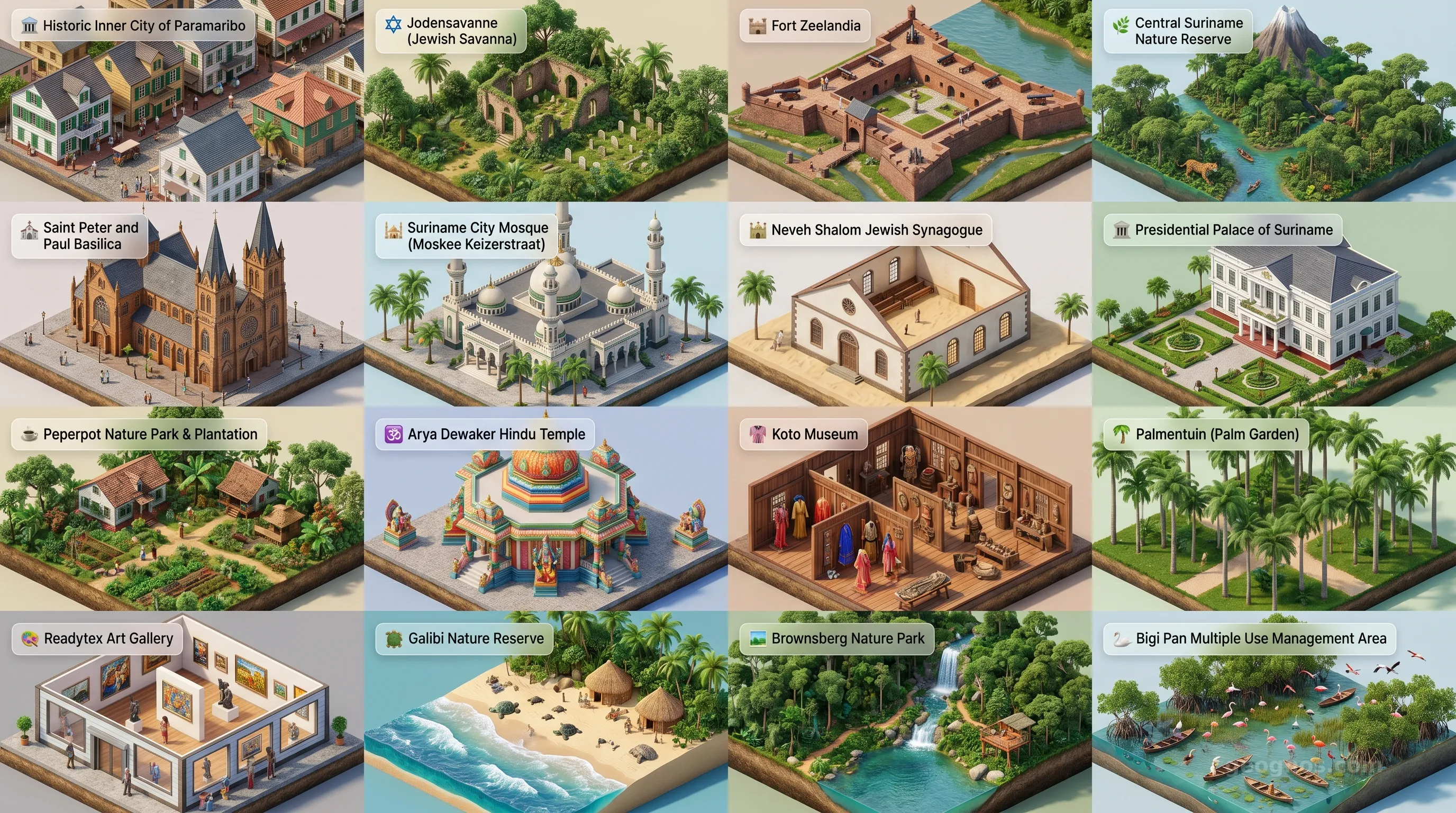
Environmentally, Suriname is a global anomaly. While much of the Amazon region grapples with the pressures of industrial exploitation, Suriname maintains an exceptionally high forest cover. It acts as a biological vault, holding an immense diversity of endemic species within its nature reserves, such as the Central Suriname Nature Reserve. This is not merely an asset of national beauty; it is a vital service to the planet's atmospheric health. For those who want to see the majesty of this terrain and the architectural wonders that define its towns, the POI cinematic showcase provides a breathtaking visual journey through the country’s most iconic locations.
The river systems, such as the Marowijne and the Coppename, act as highways for culture and commerce. These waterways do not merely divide the land; they connect the interior to the sea, facilitating a lifestyle that has remained sustainable for generations. Teachers looking for supplementary materials to explain these complex historical shifts and geographical realities will find a rich archive in the history cinematic showcase, which pairs high-quality visual aids with expert narratives to illuminate the key events that transformed a colonial plantation colony into a sovereign, multicultural republic.
A Legacy of Resilience and Discovery
Suriname is often described as a country that walks at its own pace. It does not feel the frantic urgency of larger economies, preferring to let the natural environment guide the speed of life. It is a nation of immense humility, harboring ancient secrets beneath its thick forest floor and within the shifting tides of the Atlantic coast. For the visitor, the educator, or the student of cultural history, Suriname represents a profound lesson in patience, diversity, and the importance of environmental stewardship.
As you delve into the remaining pages of this atlas, consider the scale of what you are observing. You are looking at a nation that has balanced a difficult past with an optimistic future, proving that small nations can possess a cultural gravity that rivals much larger, more globally prominent countries. Whether through the lens of its colonial wooden architecture, its complex linguistic heritage, or its unparalleled natural landscapes, Suriname invites you to look closer. There is always more to learn in this green cathedral, where history is not merely read in books but felt in the humid air and heard in the rustle of the Guiana rainforest.