The Great Silence of the Saharan Threshold
There is a specific quality to the light in Mauritania that defies the common perception of a desert landscape as merely barren. To traverse this nation is to walk the fault line between two worlds, where the infinite, undulating sea of the Sahara spills directly into the rhythmic tides of the Atlantic. Mauritania is, by all definitions, a land of transition. It acts as the colossal hinge between the Maghreb of the north and the Sub-Saharan brilliance of the south. Here, the geography does not simply dictate the pace of life; it demands a philosophy of resilience and silence that has shaped the souls of its people for millennia.
Visitors who find themselves at the edge of the Banc d'Arguin or standing beneath the towering cliffs of the Adrar plateau often feel a profound sense of temporal suspension. Mauritania is vast, quiet, and stubbornly defiant of modern sprawl. It is a place where nomadic legacies still pulse beneath the veneer of urban growth, offering a masterclass in how humanity persists when stripped down to the fundamental necessities of sun, sand, and trade.
An Archive Written in Sand and Stone
To understand the spirit of Mauritania, one must be willing to look backward as much as forward. The story of this land is not written in grand, monolithic structures that dominate the skyline, but in the layered memories of caravan routes and ancient intellectual centers. It is a narrative of nomadic scholars who carried the world's wisdom on the backs of camels, stitching together the fabric of Islamic culture and indigenous African traditions.
Those eager to connect with the roots of this identity should explore the comprehensive history of Mauritania to understand how Berber and Arab migrations collided and converged to form the modern Mauritanian mosaic. This, however, is a narrative that is better experienced than simply read. For those who find satisfaction in testing their grasp of these transformative eras, we invite you to engage with our interactive Mauritania history puzzle, a chronological journey where you must align the key moments of this nation's past to unlock specialized badges of achievement.
Visualizing the Ancient Echoes
The history of Mauritania is perhaps best understood as a series of movements across the desert, a dance between sedentary outposts and the nomadic drive for freedom. To see this transition through a curated lens, you can view our cinematic showcase of Mauritanian historical events, which utilizes vivid illustrations and historical analysis to animate the events that forged a nation from the sands of the Sahara.
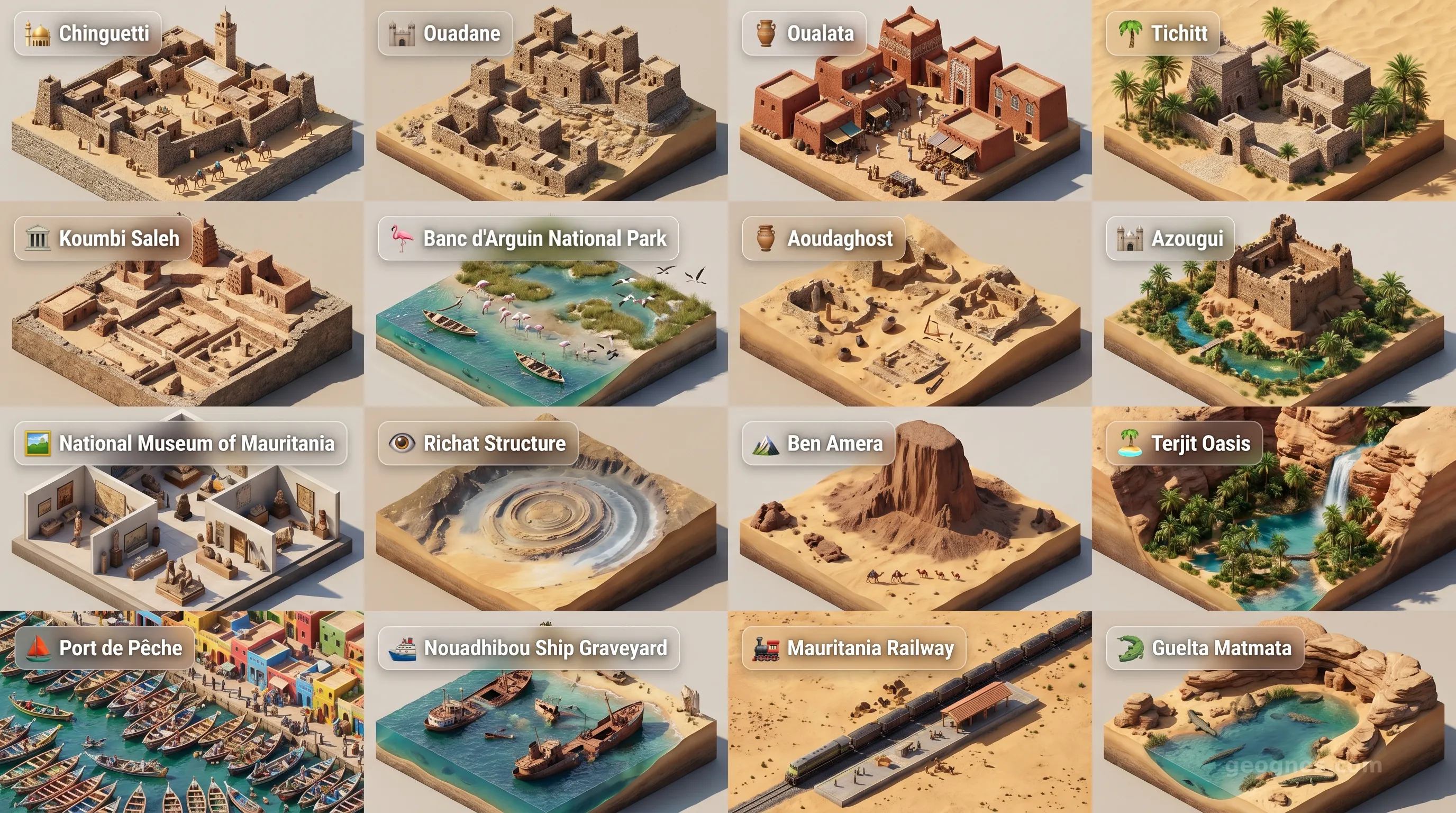
Modern travelers and historians alike often ask what remains of this grand timeline. The physical markers of Mauritania are as varied as they are beautiful. From the hidden, mud-brick libraries of Chinguetti—the seventh holiest city in the Islamic world—to the windswept colonial architecture of Saint-Louis, there is an incredible breadth to behold. We highly recommend that you browse our cinematic showcase of major Mauritanian points of interest to fully appreciate the diversity of landscape and heritage sites that wait for those willing to venture off the beaten path.
A Geography of Extremes and Opportunity
Mauritania’s landmass, one of the largest in Africa, is defined by its dramatic regional stratification. The northern expanse is dominated by the Saharan Hamadas, vast stony plateaus and high-altitude fields of shifting dunes that challenge even the most experienced navigator. Moving south, the terrain softens into the Sahel, a region of intermittent scrubland that serves as the lifeblood of the nation, providing a tenuous green zone that sustains pastoralists and subsistence agriculture.
This environment is not a limitation but a teacher. It forces an economy centered on mineral extraction, such as iron ore from the formidable deposits of Zouerate, and a vibrant coastal maritime industry where the cool currents of the Atlantic create one of the world's most productive fishing zones. In these sectors, the nation is steadily carving out a role on the global stage, proving that a sparse environment can nurture a sophisticated economic engine.
The Cultural Fabric: A Bridge Across the Sahel
The true essence of Mauritania lies in its demographic texture. It is a vibrant blend of the Beidane, the Haratin, and various sub-Saharan ethnic groups such as the Halpulaar, Soninke, and Wolof. This mix is not merely an intersection of bloodlines; it is an intersection of civilizations. Traditional hospitality is not a polite custom here; it is an existential requirement. To share tea in a desert tent, moving through the three prescribed glasses—each representing a stage of life and a level of friendship—is to experience the true heartbeat of the Mauritanian people.
As GeoGnos.com guides you through this vast, shifting, and deeply welcoming land, we invite you to observe the country not as a remote desert nation, but as a gateway. It is a doorway for the traveler, a laboratory for the historian, and a landscape of awe for the geographer. Mauritania stands tall, not in the height of its buildings, but in the depth of its patience and the enduring resilience of its golden horizon.