The Lion Mountain: A Land of Resilience and Resplendent Coasts
Sierra Leone sits on the southwestern corner of the West African bulge, a landscape defined by the dramatic meeting of jagged, verdant mountains and the churning, crystalline waters of the Atlantic Ocean. When Portuguese explorer Pedro de Sintra sailed these shores in 1462, the thunderstorms echoing against the rugged peninsula led him to name the territory Serra Leoa, or the Lion Mountain. Today, that name remains a perfect metaphor for the nation, a place of indomitable spirit, intense natural beauty, and a complex historical narrative that spans centuries of human migration, struggle, and triumphant reclamation.
To stand upon the sands of Banana Island or look out from the heights of the Loma Mountains is to encounter a nation that defies simple categorization. It is a country of paradoxes, where deep historical scars are mirrored by a profound sense of communal resilience and a burgeoning optimism that is palpably felt in the bustling markets of Freetown. As we begin our journey into this remarkable nation, we must first appreciate that the true soul of Sierra Leone lies not merely in its land, but in the layers of experience that have molded its people into one of the most culturally vibrant groups on the African continent.
The Echoes of Time: Weaving the Sierra Leonean Narrative
Understanding Sierra Leone requires an appreciation for its unique position as a gateway. Long before the era of Atlantic trade, the coastal lowlands and the mountainous hinterlands were home to diverse groups, including the Temne and the Limba, who developed sophisticated social structures within the tropical rainforests. The story of this land is not just local, but global, reflecting the movements of people, ideas, and industries across oceans. For those who wish to delve into the foundational narratives that built this nation, you are invited to explore the history of Sierra Leone, which outlines the complex milestones from early indigenous settlement through the colonial period and into the era of modern nationhood.
The historical weight of Sierra Leone is perhaps most poignantly felt in the Freetown Peninsula, where the landscape is peppered with markers of memory. As an educational resource, we encourage students and history enthusiasts to test their knowledge of the timeline of these events by engaging with our history puzzle. By arranging the defining moments of the nation in their correct sequence, learners can gain a clearer understanding of how the past acts as a tether to the present.
Beyond the pages of textbooks, the story of Sierra Leone is best experienced through a sensory journey. We have curated a sophisticated collection of archival illustrations and commemorative depictions of major historical turning points to help bring the past into sharp focus. You can witness these transformative moments through our history cinematic showcase, an immersive tool designed to bridge the gap between academic research and visual appreciation.
Beyond the Mountains: A Geography of Splendor
While history provides the bones of the country, geography provides the vibrant flesh. The coastal strip of Sierra Leone is defined by long, sweeping beaches that are perhaps the most underrated in all of West Africa. Tokeh and River Number Two beaches, with their turquoise waters and backdrop of dense green foliage, offer a vision of paradise that is becoming increasingly known to international travelers. Traveling inland, the terrain climbs toward the Guinea Highlands, where Mount Bintumani rises to become the highest point in the nation. These mountains act as a cooling relief and a source for the country's many rivers, which nourish the vast agricultural lowlands below.
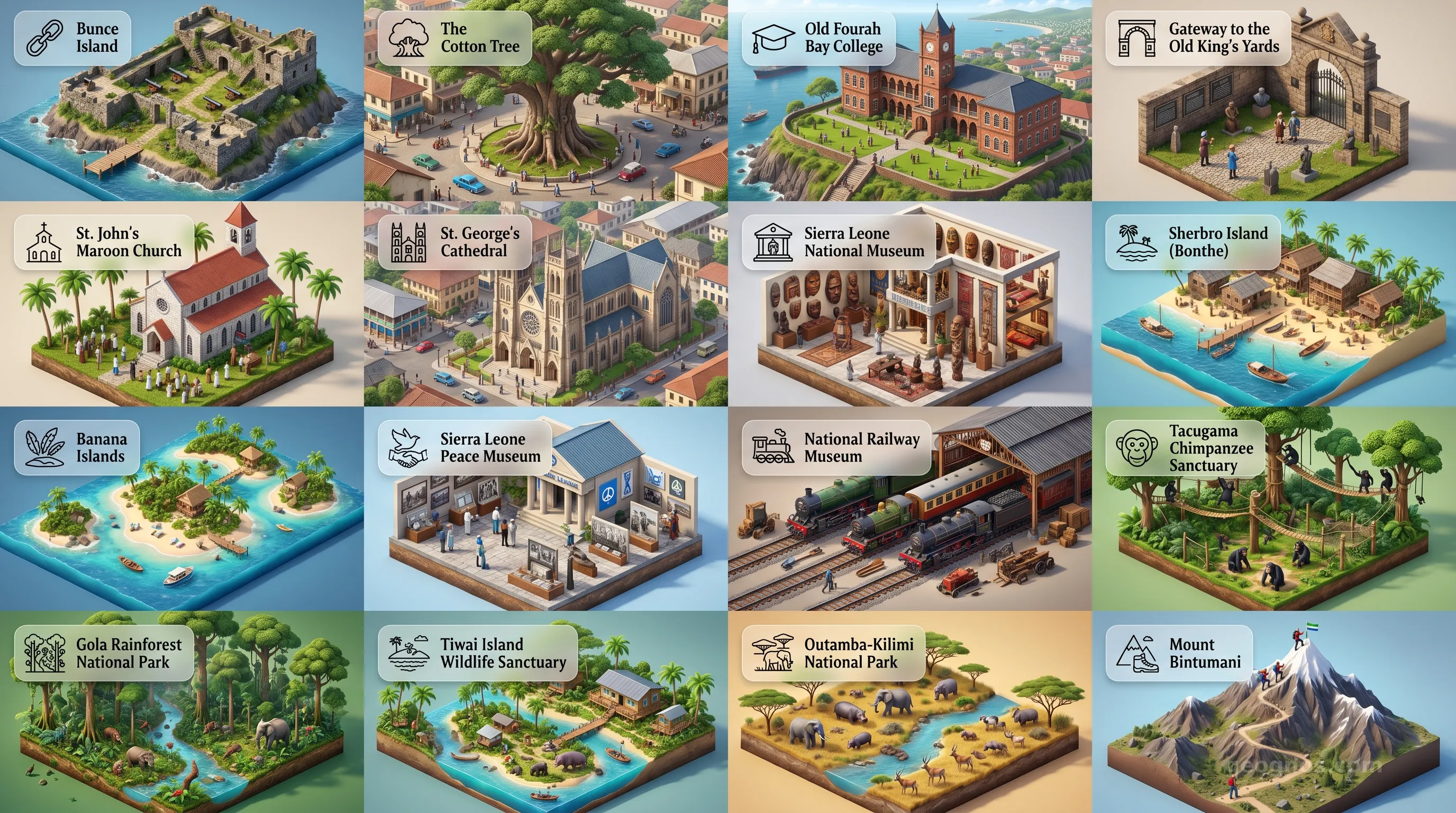
The climate is quintessential West African tropical, defined by distinct wet and dry seasons. This oscillation dictates the rhythm of rural life, from the planting of upland rice to the festive celebrations that accompany the harvests. For those preparing to travel or for students mapping the terrain, understanding these distinct ecological zones is key to grasping the local lifestyle. We invite you to experience the beauty of these natural landmarks and cultural centers through our POI cinematic showcase, where you can explore the rugged peaks and serene coastlines of this magnificent West African nation.
A Cultural Crossroads of Unyielding Spirit
The people of Sierra Leone represent a diverse tapestry of backgrounds and ethnicities. From the Krio people of the coastal areas, with their unique blend of African, European, and American heritage, to the Mende and Temne peoples who comprise the largest ethnic groups, the nation is a masterclass in synthesis. This multicultural identity is most visible in the vibrant, syncretic celebrations of the Freetown street life, the sophisticated masquerades that still hold deep spiritual meaning, and a national cuisine that emphasizes the abundance of the sea and the richness of the soil.
Sierra Leone’s modern era is one of focus and growth. The nation is increasingly looking toward its potential in sustainable tourism, mining, and sustainable agriculture as it stabilizes its economic future. The presence of international scholars and volunteers across the country serves as a testament to the ongoing dialogue between Sierra Leone and the global community. It is a nation that asks its visitors to listen closely and to look beyond the surface, recognizing that every smile, every dish, and every monument in this land tells a story of survival and, more importantly, of sustained success.
In this GeoGnos portrait, we have barely scratched the surface of what Sierra Leone holds for the curious mind. Whether you are a student piecing together the timeline of West African development, or a dreamer looking at maps and planning a trek into the cool mist of the Loma Mountains, this land will leave an indelible mark on you. The Lion Mountain is awake, vibrant, and waiting to share its profound heritage with the world.