The Water Tower of West Africa
To stand upon the soil of Guinea is to feel the pulse of West Africa itself. Often called the water tower of the region, this nation occupies a unique geographic vantage point that dictates the rhythm of life for its neighbors. While many nations are defined by a singular horizon, Guinea is a study in vertical and hydrological contrast. It is the birthplace of the great rivers, where the Niger, the Senegal, and the Gambia begin their meandering journeys toward the Atlantic, carving the very lifeblood of the continent into the landscape. This is not merely a country of borders; it is a geographic catalyst, a mountainous cradle that feeds the lowlands and defines the ecological legacy of a vast territory.
The soul of Guinea resides in this flow. Its geography is a dramatic gradient, shifting from the dense, misty heights of the Fouta Djallon highlands, which dominate the central interior like a majestic green fortress, to the lush, humid mangroves that hug the Atlantic coast. To understand the nation is to traverse this slope, witnessing how the steep valleys have acted as historical refuges and cultural silos, nurturing distinct traditions, languages, and philosophies. It is a land where geology is not merely scenery but the foundation upon which its complex and proud identity is built.
A Heritage of Resilience and Sovereignty
The history of Guinea is as complex and layered as its diverse topography. For those seeking to immerse themselves in the deep currents of its past, you can explore the full history of Guinea, an examination of how ancient empires, colonial influences, and the drive for modern statehood have woven a narrative of persistent, unwavering sovereignty. The legacy of leaders like Samori Touré continues to resonate through the oral traditions of the Mandinka and Fulani people, serving as a reminder that the borders drawn by maps have never fully contained the spirit of the Guinean people.
Engaging with history in the digital age requires both depth and interactivity. Students and curious minds can test their mastery of these milestones through our interactive history chronology puzzle, where arranging key events provides not only a deeper chronological understanding but also rewarding recognition for your intellectual effort. By mapping the transition from kingdoms to colonial administration and finally to independence, learners begin to see the human hand behind the mountain passes and river valleys.
To complement this narrative journey, we have curated a sensory bridge that links the past to the present. You are invited to view our history cinematic showcase, a collection of artistic interpretations that brings the momentous events of Guinea to life through visual storytelling. These illustrations transform abstract dates into vivid scenes of resilience, trade, and cultural preservation, offering a cinematic perspective that textbooks alone cannot provide.
The Crossroads of Culture and Landscape
Guinea’s identity is perpetually renewed by the interplay between its mountainous core and its maritime gateways. The capital, Conakry, situated on the Kaloum Peninsula, serves as the bustling administrative and economic heart of the nation, acting as a portal between the vibrant, traditional life of the highlands and the interconnected world of global commerce. It is here that the synthesis of Guinean modernism feels most palpable, where music, art, and daily commerce harmonize with the humid, salt-kissed air of the Atlantic.
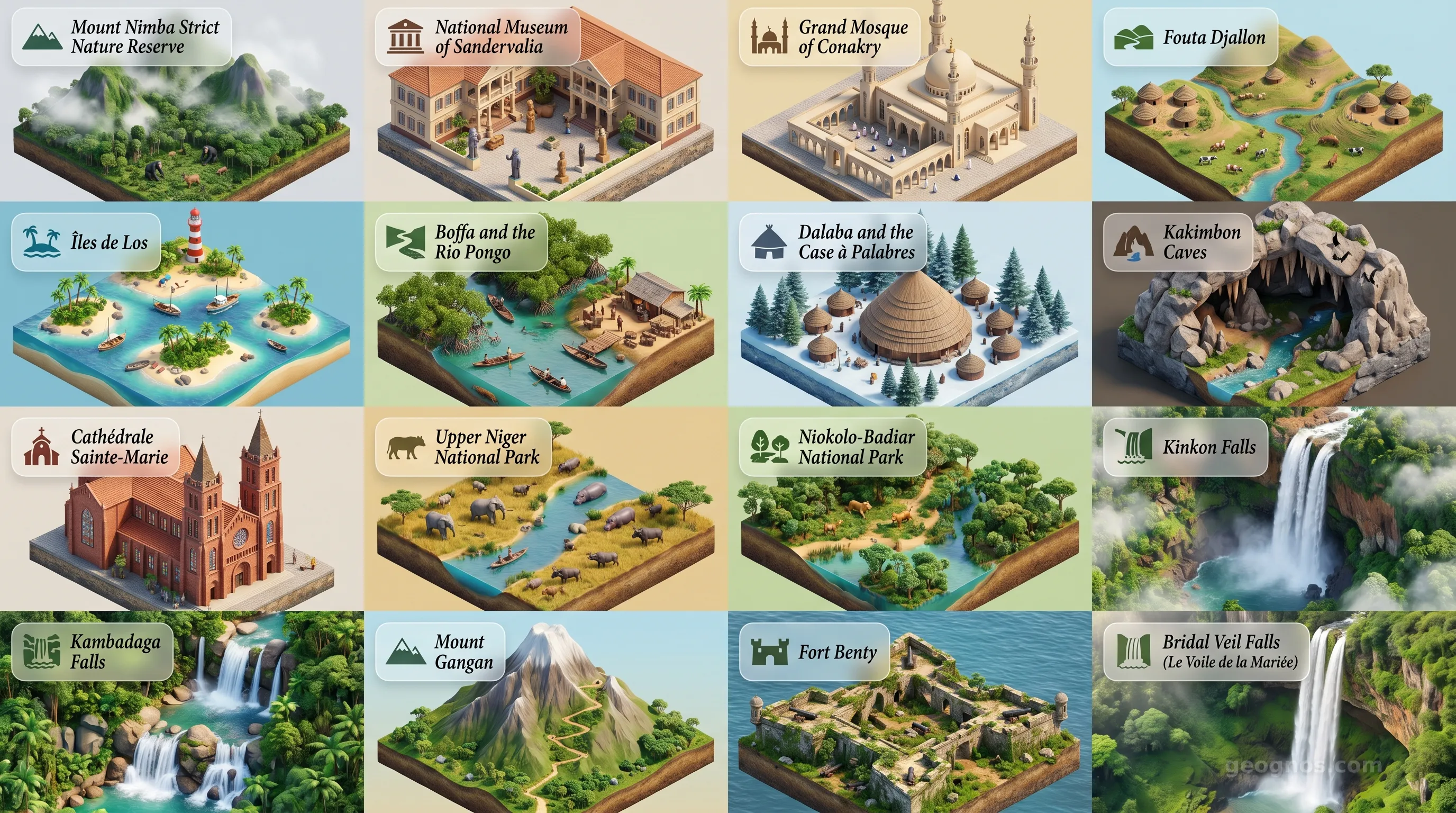
Beyond the cities, the rugged terrain of the Fouta Djallon invites exploration. Its high-altitude plains and dramatic waterfalls—some of the highest in West Africa—represent an untouched frontier for the environmentally conscious traveler. To get a closer look at the iconic landscapes, protected wildlife sanctuaries, and architectural heritage sites that define the nation’s aesthetic, be sure to experience the POI cinematic showcase. These vignettes display the breathtaking vistas that earn Guinea its status as one of Africa’s most underrated natural paradises.
Geographical Stewardship and Global Significance
Why does a nation so rich in mineral wealth, hydro-electric potential, and biodiversity matter on a global scale? Guinea serves as a critical guardian of West Africa’s hydrological health. Its mountains trap the rain that fills the basins of the most vital river systems, providing sustainable water to millions of people in nations far beyond its own borders. As the global climate fluctuates, the role of Guinea’s forests and highlands becomes an international imperative.
However, the value of Guinea is not only extractive or environmental. It is a center of West African intellectualism and artistic expression. From the intricate percussion of the djembe, which found its origin in the Manden region of Guinea, to the vibrant literary traditions passed down through the griot class, the nation is a cultural powerhouse. When you travel through these landscapes, you are not merely viewing a terrain; you are engaging with a vibrant, living library of humanity that has endured by being as flexible and life-giving as the great rivers that flow from its soil.
As we delve further into the specific segments of our Atlas, remember that every aspect of the country—from its intricate government systems to the expansive reach of its transportation corridors—is informed by the primary theme of "flow." Guinea remains a nation in motion, constantly adapting its governance and economy to harness its natural abundance for the benefit of its citizens, all while preserving the ancient, rhythmic culture that defines it as the water tower of a continent.