The Eternal Crossroads: An Introduction to Afghanistan
To look upon Afghanistan is to observe the intersection of ancient worlds. It is a nation carved from the vertical ambition of the Hindu Kush, a rugged spine of earth that has served as a bridge between East and West for millennia. Here, the geography does not merely frame the story of humanity; it dictates the rhythm of life, commerce, and culture. Afghanistan exists as a testament to human resilience and an unwavering spirit of independence, standing as a high-altitude sanctuary where diverse civilizations have collided, collaborated, and coalesced.
For the traveler, the scholar, or the student, understanding this land requires shifting one's perspective from the flat plains of common perception to the complex, mountainous reality of the Central Asian plateau. The soul of Afghanistan is found in the deep valleys, the nomadic traditions, the intricate tilework of its shrines, and the profound hospitality of its people. It is a country that has invited the caravans of the Silk Road to pause, trade, and exchange ideas, resulting in a cultural tapestry that is as durable as the stone peaks that define the skyline.
A Crucible of Civilization
Afghanistan’s narrative is one of depth and transformation. To appreciate how this landscape birthed empires and welcomed scholars, philosophers, and traders, one should explore the comprehensive history of Afghanistan. The land acts as a silent witness to the passage of Cyrus the Great, Alexander the Great, and the luminaries of the Golden Age of Islam. The resulting historical landscape is not just a relic of the past but an active, breathing part of the national identity, where modern cities are often built atop layers of antiquity.
For those looking to engage with this legacy in an active way, our educational tools bring this timeline to life. You can challenge your understanding of regional developments by completing our interactive Afghanistan history puzzle. By arranging the defining moments of this region in their correct sequence, you will earn badges that testify to your mastery of the nation's complex, multifaceted timeline. This, combined with our immersive digital experiences, ensures that the history of the region is felt as a living chronicle.
The Visual Echoes of Time
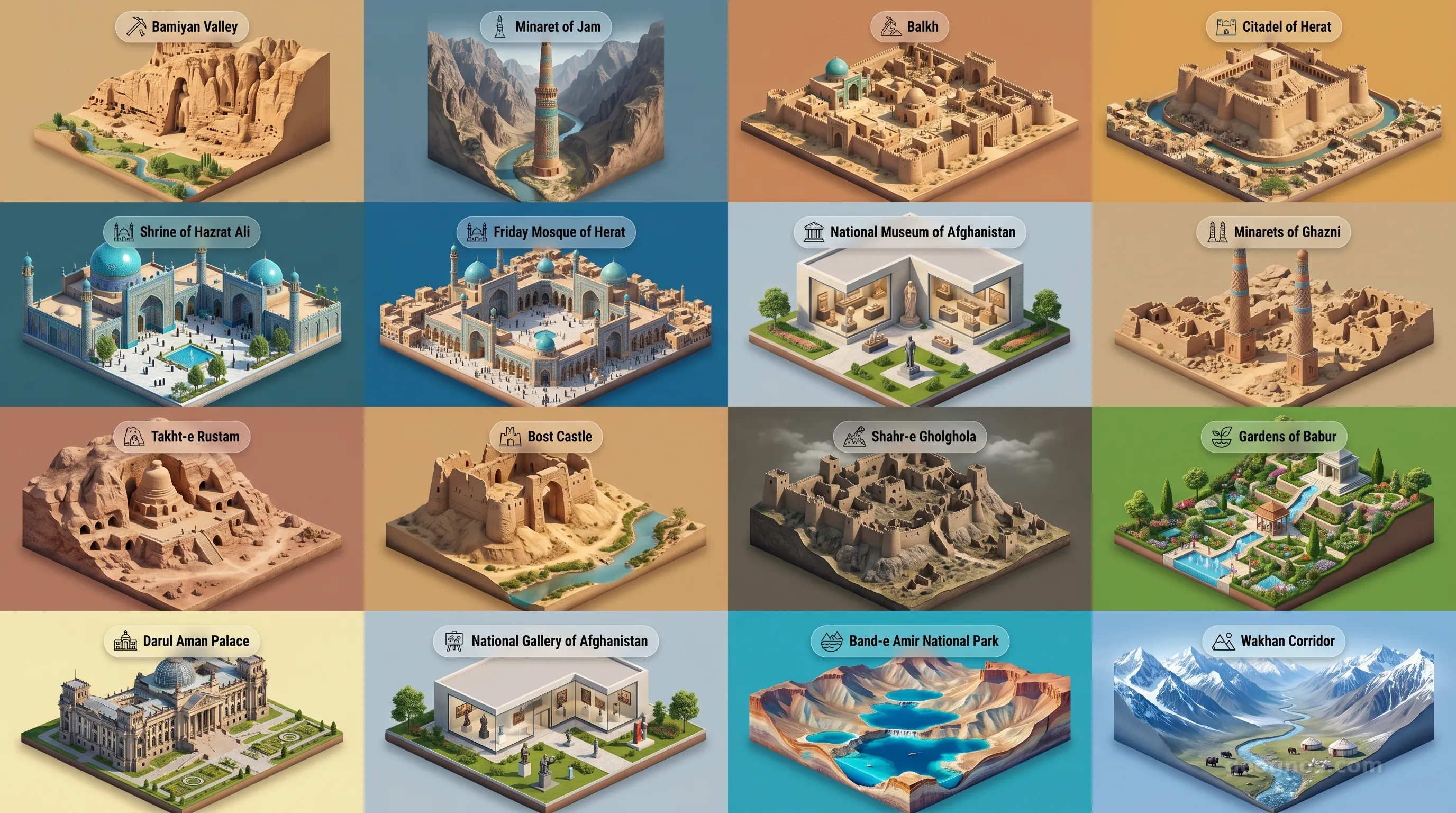
While the written record offers facts, the visual landscape provides the emotional core of the Afghan experience. From the cobalt-tiled facades of Herat to the towering, wind-swept ridges of the Wakhan Corridor, the geography is undeniably grand. We have curated a specialized history cinematic showcase to present these themes through a series of illustrated highlights. This feature allows you to cycle through the monumental events that have defined the nation's trajectory, offering a pedagogical window into the movements of armies, scholars, and trade missions that chose the path of the Hindu Kush.
Furthermore, because the spirit of a country is inherently tied to the spaces it occupies, we invite you to take a journey through our comprehensive points of interest cinematic showcase. This carousel highlights the architectural marvels, the stunning natural vistas, and the quiet beauty of rural provinces. It serves as an essential primer for those preparing to understand the geographical diversity that characterizes this unique land.
The High Mountain Spirit
What makes Afghanistan truly unique on the world stage is its stubborn resistance to being categorized. It is neither fully Middle Eastern nor purely South Asian or Central Asian. Instead, it is the quintessential Himalayan pivot point. Its climate, which varies wildly from the arid desert basins of the south to the subarctic heights of the north, has forced a specialized development of agriculture and community. The melting snows of the Hindu Kush provide the lifeblood of the nation, nourishing the green river valleys that provide stark contrast to the surrounding barren heights.
The population of Afghanistan mirrors this environmental diversity. It is a mosaic of ethnicities and languages, united by a shared history of hospitality known locally as Pashtunwali in many regions, a cultural code that emphasizes respect, protection, and kindness to travelers. This value system, honed in an environment where individual survival depended on the support of one’s neighbor, remains the social bedrock of the country today. Whether in the bustling marketplaces of Kabul or the remote, verdant valleys of the Nuristan region, the heartbeat of the nation is found in the connection between its people and the land they cultivate.
Looking Toward the Horizon
Afghanistan represents an immense opportunity for students and curious minds to study how geographical isolation and cultural connectivity can exist simultaneously. As a global society, we find ourselves better for knowing the intricacies of this proud, mountainous state. Whether you are investigating the economic potential of its rare minerals, studying the resilience of its ancient irrigation systems, or simply admiring the craftsmanship of its artisanal textiles, you are engaging with a legacy that refuses to fade. The story of Afghanistan is one of endurance, brilliance, and an enduring commitment to maintaining a way of life that values the preservation of history alongside the embrace of an ever-changing modern world.
We welcome you to delve deeper into these sections on GeoGnos.com as we explore the 3D topography, the governmental structures, and the vibrant economic tapestry of a nation that remains, for many, the final frontier of discovery.