The Land of Eternal Confluence
To stand upon the soil of Pakistan is to stand at the intersection of worlds. It is a nation defined not by borders, but by the relentless convergence of geological majesty and cultural endurance. From the jagged, ice-crowned peaks of the Karakoram range in the north to the tranquil, silt-laden embrace of the Indus River as it reaches the Arabian Sea, Pakistan possesses a geography that has acted as a gravitational pull for humanity for millennia. It is a land where the whispers of the ancient Indus Valley Civilization still echo through the bazaars of Lahore and the high-altitude valleys of Hunza. This is not merely a country; it is a repository of human memory, a landscape that has forged civilizations and welcomed travelers along the fabled Silk Road.
For those who seek to understand the structural evolution of this region, one must dive into the layered narrative of its past. We invite you to explore the comprehensive history of Pakistan, a detailed account that maps the transition from ancient urban centers like Mohenjo-daro to the dynamic political tapestry of the modern state. Understanding these shifts is the key to unlocking the soul of the people, whose hospitality is as vast as the Deosai Plains.
A Crucible of Civilization and Memory
Pakistan occupies a unique position as a geographic funnel. Throughout history, the mountain passes of the Hindu Kush and the arid stretches of Balochistan have served as gateways for migrations, commerce, and intellectual exchange. This mobility has endowed the nation with a syncretic identity, blending Persian, Central Asian, South Asian, and Islamic influences into a singular cultural experience. The music of the qawwali, the intricate geometries of Mughal architecture, and the resilient agricultural practices of the Punjab plains are all artifacts of this perpetual movement.
For the student of time, grasping this chronology is a rewarding endeavor. As you reflect on the rise of the Maurya, the brilliance of the Kushan Empire, and the eventual formation of a sovereign state, you may wish to test your analytical skills. You can challenge yourself with our history puzzle, an interactive experience where you will arrange the monumental milestones of this nation in their rightful chronological order to earn your scholar’s badge.
The Visual Tapestry of Time
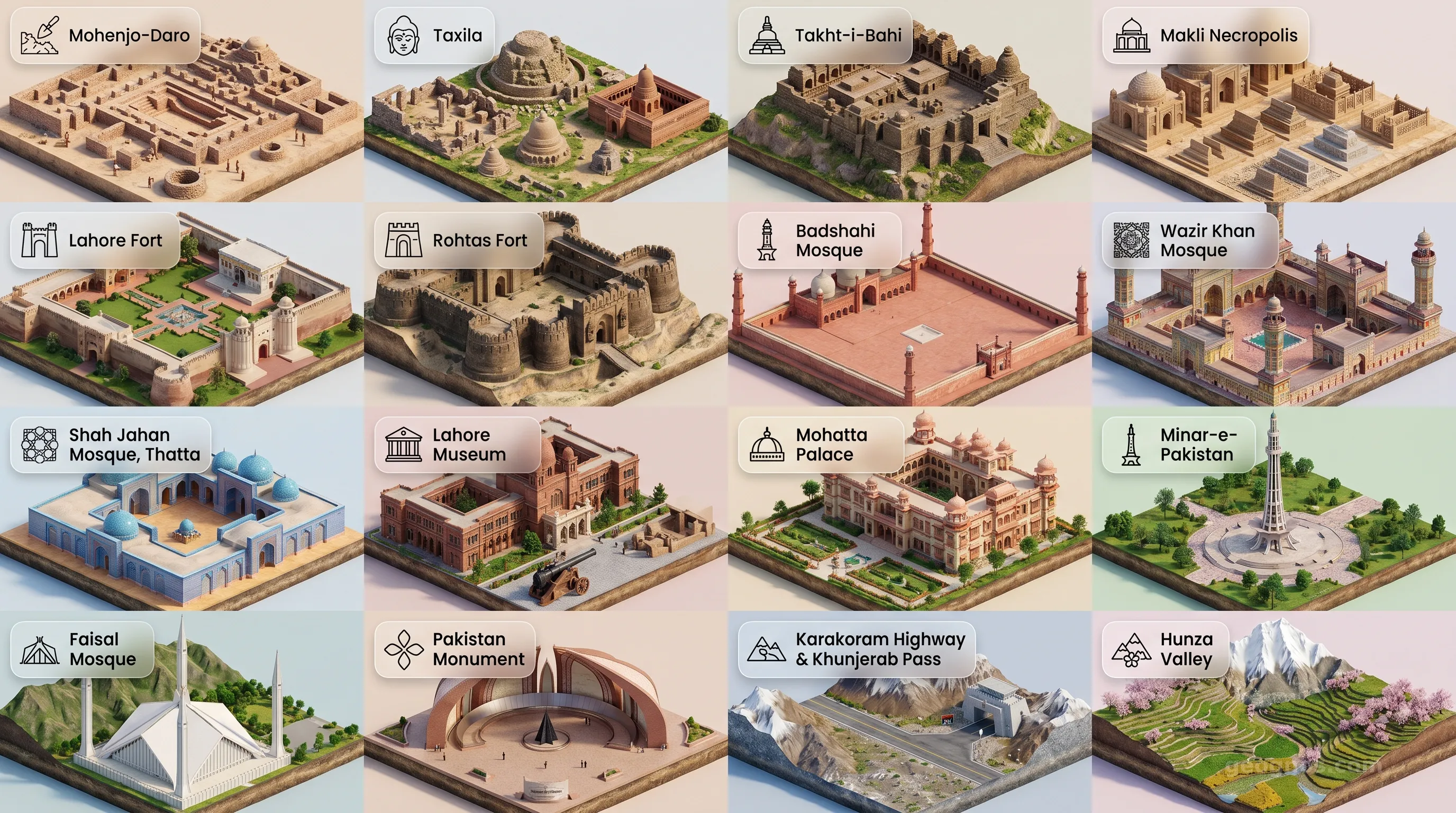
The history of Pakistan is not just a subject for the written word. It is a living, breathing heritage found in the stone of the Buddhist monasteries of Taxila and the vibrant, polychromatic frescoes of Wazir Khan Mosque. Because the physical evidence of this history is spread across vast distances, we have curated a specialized resource to bridge that gap. We encourage you to immerse yourself in our history cinematic showcase, where you can watch the progression of eras illustrated through evocative imagery, summarized to help you grasp the weight and wonder of the events that sculpted the Pakistani identity.
The Living Landscape: Peaks, Plains, and Rivers
Geographically, Pakistan is a theater of extremes. In the north, the collision of the Eurasian and Indian tectonic plates continues to thrust the Himalayas, the Karakoram, and the Hindu Kush into the clouds. These giants, including K2 and Nanga Parbat, serve as the world’s grandest water towers, feeding the mighty Indus River. This river is the literal lifeline of the nation, nourishing the vast, fertile alluvial plains that have sustained populations since the dawn of urban history. Southward, the topography transitions into the arid heat of the Thar Desert, before finally meeting the Arabian Sea at the bustling, salty ports of Karachi.
The beauty of this geography is best understood through its specific, iconic vistas. From the glacial lakes of Shimshal to the winding architectural marvels of the old walled cities, the points of interest are as diverse as the climate zones themselves. For those dreaming of a journey through these high-altitude passes or the serene historical courtyards, you should visit our POI cinematic showcase, a dynamic player designed to transport you visually through the most significant landscapes and historical landmarks across the provinces.
A Future Rooted in Tradition
As we navigate the 21st century, Pakistan remains a focal point for global attention, not merely because of its strategic position, but because of its resilient spirit. The youth of Pakistan, a large and energetic demographic, are currently redefining the nation’s role in technology, art, and sustainable development. Their story is the latest chapter in a book that began in the river valleys five thousand years ago. Whether it is through the preservation of high-altitude ecosystems or the advancement of global logistics, the nation continues to honor its roots while reaching toward a transformative future. The traveler who visits today will find not only a land of breathtaking mountains and hospitable hearts, but a nation that is actively dialoguing with its past to engineer its progress.