Africa in Miniature: Unveiling the Soul of Cameroon
To travel through Cameroon is to undertake a journey across the entire continent of Africa without ever crossing a border. Known to geographers and explorers alike as "Africa in Miniature," this nation possesses a rare and breathtaking convergence of ecosystems, cultures, and topographies. From the sun-drenched savannahs of the north to the mist-shrouded peaks of the central highlands and the sultry, tide-swept mangroves of the Atlantic coast, Cameroon serves as a bridge between West and Central Africa. It is a place where the Atlantic Ocean whispers against volcanic sand, and where the rhythmic heart of the continent pulses with the diversity of over two hundred distinct ethnic groups.
Understanding the layers of this landscape requires a look backward. When we explore the history of Cameroon, we encounter a chronicle of colonial ambition, rich ancestral traditions, and the resilient evolution of a modern nation-state. Its past is not merely a collection of dates, but a living dialogue between the ancient kingdoms of the north and the complex colonial legacies that left an indelible mark on the country's dual linguistic identity of French and English.
A Geological and Cultural Crossroads
What defines the Cameroonian spirit is its inherent dynamism. The landscape rises sharply from the Bight of Biafra at the base of Mount Cameroon, an active stratovolcano that stands as the highest point in Western and Central Africa. This mountain is not only a sentinel over the coast but a symbol of the country's untamable natural beauty. Traveling inland, the terrain softens into the rolling grasslands of the Bamenda Highlands, known for their cooler temperatures and intricate chiefdoms that have maintained royal traditions for centuries. Further north, the landscape transforms again, yielding to the harsh but majestic beauty of the Waza National Park, where the horizon stretches flat and wide, echoing the geography of the Sahel.
For those looking to engage with this past in a more tactile way, we encourage you to challenge your knowledge. You can test your expertise with our interactive history puzzle, where arranging key turning points in chronological order allows you to track the growth of this nation and earn recognition for your dedication to learning. The story of Cameroon is a layered one, and understanding its sequence is essential to appreciating its present-day harmony.
The Living Mosaic of Human Geography
The true essence of Cameroon resides in its people. In the markets of Douala, the nation's economic powerhouse, one hears a symphony of languages, from Bantu dialects to the distinct pidgins that have evolved to bridge linguistic divides. In the north, the architecture of the Hausa and Fulani cultures reveals mud-brick craftsmanship designed to withstand the heat, while in the southern forests, the deep connection to the land practiced by various forest-dwelling communities highlights a centuries-old environmental stewardship.
Visual learners will find much to admire as they delve into the aesthetics of this landscape. We invite you to immerse yourself in our history cinematic showcase, which presents the most significant chapters of Cameroon's national evolution through high-quality illustrations and narrated context. These snapshots offer a profound glimpse into the milestones that shaped the borders and the culture we see today, bridging the gap between historical fact and narrative wonder.
A Gateway to Biodiversity and Beauty
Beyond the cities and the historical archives, Cameroon offers a natural bounty that remains one of the world's best-kept secrets for eco-travelers. The Lobéké National Park is part of the legendary Congo Basin, the second-largest rainforest on the planet, sheltering elusive western lowland gorillas, forest elephants, and a mesmerizing array of avian life. The contrast between these lush, humid jungles and the arid plateaus of the north demonstrates the extreme range of habitats packed into one sovereign territory.
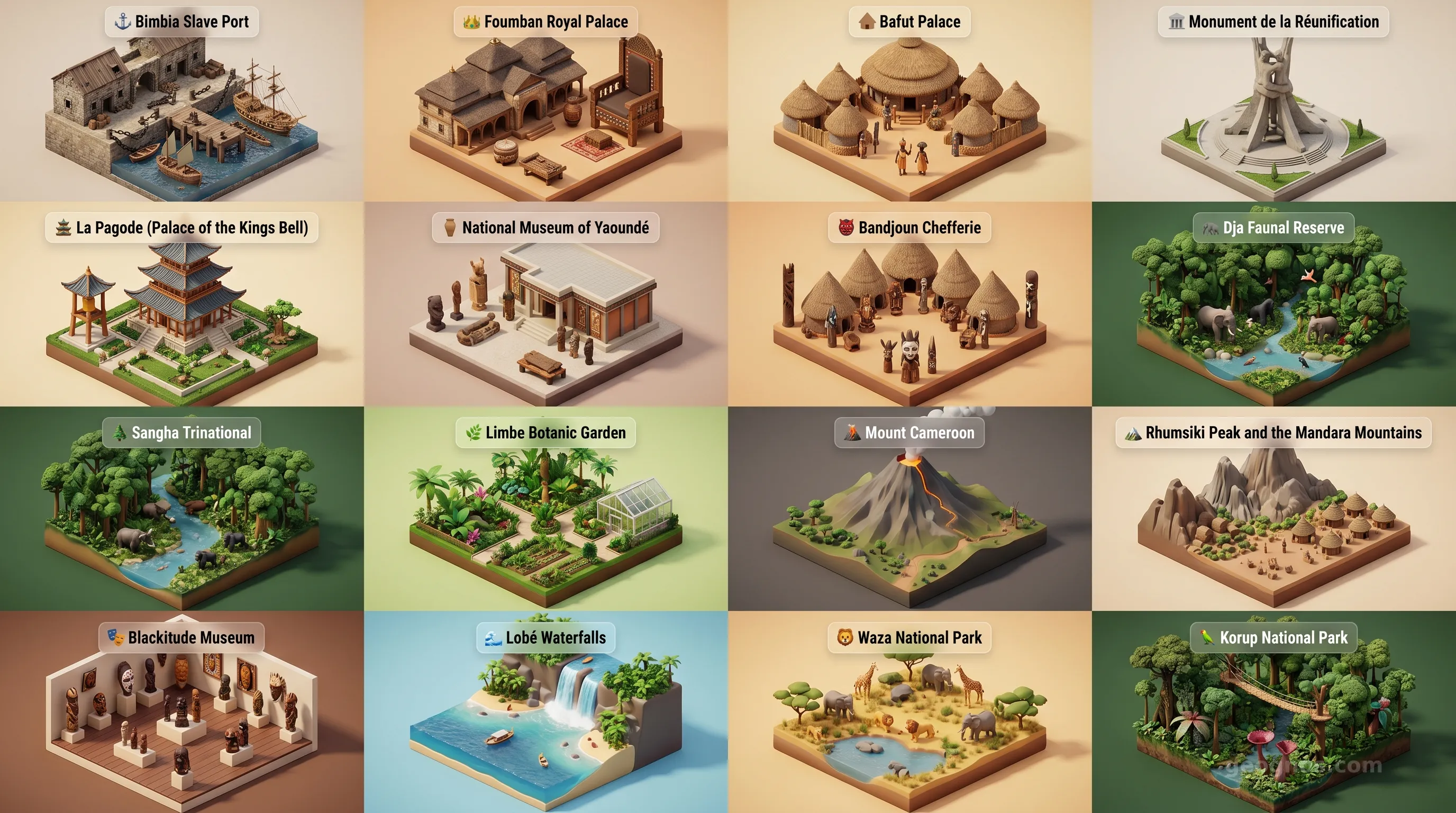
Whether you are a scholar researching regional dynamics, a teacher developing a curriculum on West Africa, or a traveler sketching out an itinerary, there are visual treasures waiting to be discovered across the country. You can discover the beauty of Cameroon through our curated POI cinematic showcase, which takes you on a tour of the country's most essential locations. From the colonial-era architecture of Buea to the bustling port activities of Kribi, this collection of imagery captures the visual soul of a nation that refuses to be categorized by a single climate or a single aesthetic.
Building Knowledge at GeoGnos
As we delve deeper into the specifics of the Cameroonian experience, keep in mind that this land serves as a perfect case study for the interplay between geography and sociology. Its strategic position in the Gulf of Guinea has made it a crucial maritime hub, while its varied elevation provides the agriculture necessary to support its growing, youthful population. As a hub of education, we aim to provide you with the resources to look past the surface and engage with the structural, environmental, and human elements that make Cameroon an anchor of stability and cultural complexity in Central Africa.
Through this comprehensive overview, we hope to provide both the inspiration and the data necessary to foster a deeper connection to this remarkable nation. As you progress through our atlas, consider how the mountains dictate migration patterns, how the climate influences the local trade, and how the rich tapestry of tradition continues to thrive amidst the pressures of a globalized world. Cameroon is more than just a destination on a map. It is a living, breathing testament to the vitality of the African continent.