The Eternal Arteries of Civilization
To stand upon the banks of the Nile is to witness the rhythmic pulse of human history. Egypt is not merely a country in the conventional sense. It is a geological miracle, a ribbon of emerald green life forced through the vast, arid desolation of the Sahara. The Nile, stretching like an obsidian spine through the heart of the landscape, has dictated the cadence of life for over five millennia. Here, the interplay between the unpredictable flood and the enduring stone created a culture defined by an obsession with permanence and the cyclical nature of time. This is the birthplace of geometry, of monumental architecture, and of a concept of divinity that sought to mirror the stability of the natural order.
When you walk through the dust of the Giza Plateau or navigate the bustling, aromatic alleyways of Islamic Cairo, you are tracing the footsteps of ancients who stared into the stars and saw their own reflections. Egypt functions as the world's grand outdoor museum, a place where geography was destiny. To fully grasp how the fertile floodplains and the protecting deserts sculpted the worldview of its people, you must first explore the history of Egypt. Through this deeper study, you will see how early agricultural communities coalesced into the world's first centralized nation state.
The Geometry of Sovereignty
The geography of Egypt is a study in binary extremes. The "Black Land" of the river delta and the valley stands in stark, binary opposition to the "Red Land" of the encroaching desert. This dualism is reflected in every aspect of Egyptian life, from the Pharaohs who wore the double crown of Upper and Lower Egypt to the mythological struggle between Horus and Set. The desert, while hostile to settlement, provided a massive, impenetrable buffer that allowed the culture to develop with remarkable stability and independence for thousands of years. It served as an ancient shield, guarding the delicate irrigation systems upon which the society thrived.
As you synthesize the grand timeline of dynasties, kingdoms, and external influences that have moved through the Nile Valley, it helps to challenge your intuition. If you feel confident in your grasp of the succession of Persian, Macedonian, Roman, and Arab influences that have layered themselves onto this ancient foundation, test your knowledge with our History Puzzle. Placing these eras in the correct chronological order is the ultimate rite of passage for every GeoGnos visitor, rewarding those who can untangle the complexities of this long, storied civilization.
A Visual Legacy of Monumentality
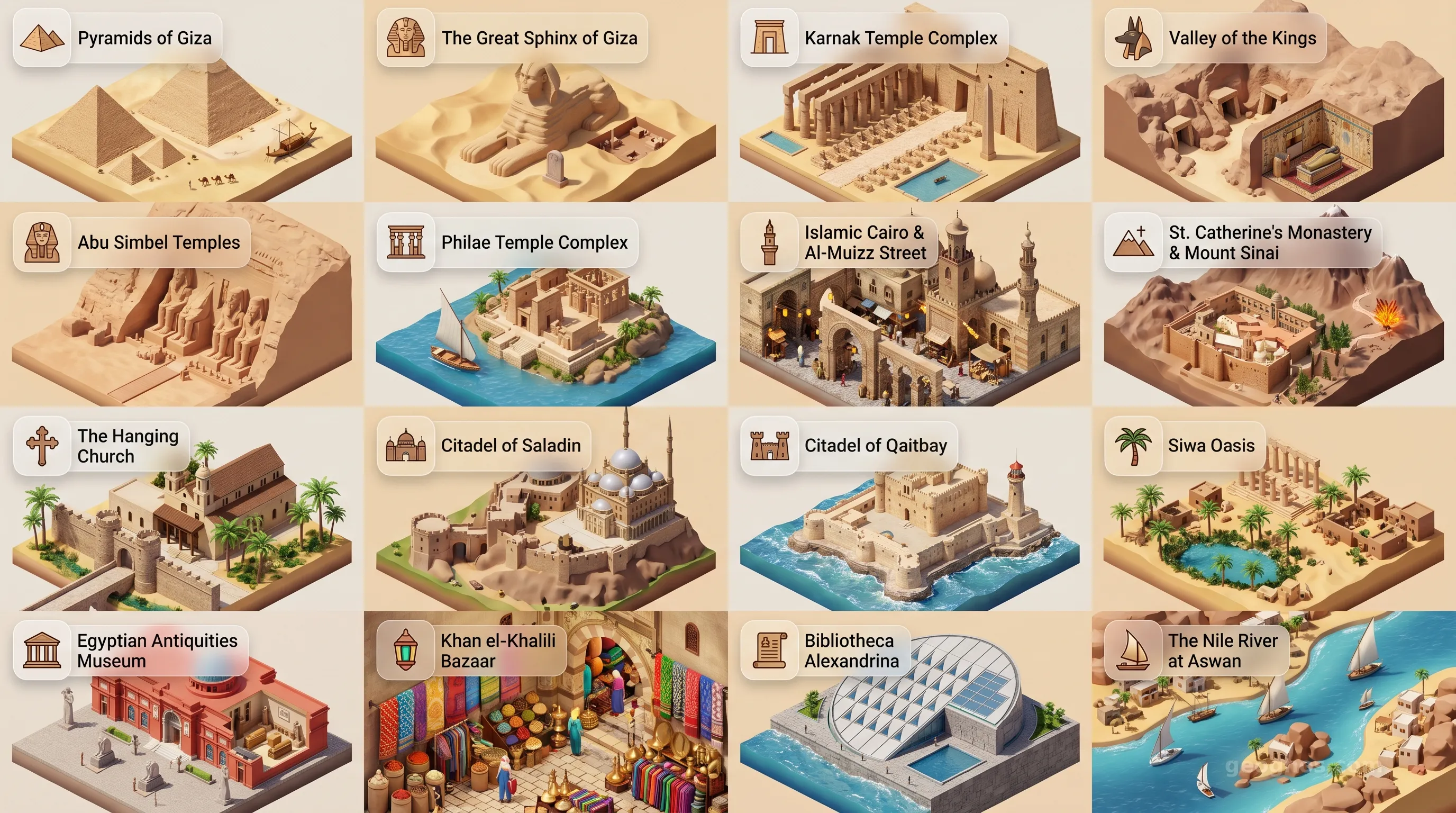
The Egyptian spirit is articulated through stone. From the colossal pyramids designed as resurrection machines to the delicate papyrus scrolls hidden in the depths of desert tombs, the architecture of Egypt was built for eternity. Travelers and scholars alike find themselves humbled by the scale of sites such as the Temple of Karnak or the hypostyle halls of Abu Simbel. There is a distinct, resonant silence found in these spaces, a remnant of the devotion that once permeated every pillar and threshold.
The narrative of this land is not merely written in books but is projected through the magnificent visuals of its landmarks. To appreciate the scale of these structural triumphs, we invite you to immerse yourself in our History Cinematic Showcase. This collection offers an illustrative look at the events that shaped a superpower of the ancient world. Furthermore, for those currently dreaming of their own journey to the Valley of the Kings, our POI Cinematic Showcase provides an intimate, high definition walkthrough of the country's most significant cultural touchstones, capturing the interplay of morning sunlight on weathered sandstone and the intricate inscriptions of forgotten eras.
The Intersection of Ancient Foundations and Modern Aspirations
While the shadow of the past is undeniably long, Egypt is not a stagnant monument. It is a vibrant, contemporary actor on the world stage. As the bridge between Africa and Asia, and the owner of the Suez Canal, Egypt serves as a critical junction for global commerce and cultural exchange. Today's Egyptian population is characterized by a rich tapestry of history, where the ancient Coptic traditions and the deep roots of Islamic scholarship merge with modern metropolitan energy. The bustling markets of Cairo, the coastal grace of Alexandria, and the serene tourism centers along the Red Sea speak to a nation that is constantly looking forward while resting its feet on five thousand years of solid, unyielding stone.
Egypt teaches us that identity is constructed through adaptation. Whether you are an educator introducing students to the wonders of irrigation engineering, a university researcher analyzing the development of early bureaucracy, or a curious traveler hoping to see the sunrise over the Sphinx, this country offers a limitless wealth of knowledge. We welcome you to GeoGnos as we uncover the secrets of the world, starting here, in the land of the Nile, where every grain of sand feels like a witness to history.