The Granite Sentinels of the Indian Ocean
In the vast, azure expanse of the western Indian Ocean, there exists an archipelago that defies the common perception of tropical islands. While many of the world's renowned island nations are the product of volcanic outpourings or coral accumulation, the Seychelles remains a geological anomaly. These islands are the fragmented remnants of an ancient supercontinent, Gondwana, left behind millions of years ago like granite anchors cast into the sea. This unique tectonic heritage creates a landscape of dramatic, boulder-strewn shorelines and verdant mountain spines that rise abruptly from the ocean floor, distinguishing the Seychelles from its neighbors in both character and biology.
To walk upon the sands of the Seychelles is to step into a living laboratory of evolution. Because these islands drifted away from other landmasses in the distant past, they became a biological ark, nurturing species that exist nowhere else on the planet. From the prehistoric presence of the Coco de Mer palm, which produces the world's largest seed, to the silent, slow-moving giants of the Aldabra Atoll, the geography of this nation has dictated a history of profound seclusion, followed by a remarkably diverse integration into the global community. Exploring this evolution is an essential part of understanding the islands, and those interested can explore the comprehensive history of Seychelles to better understand the forces that shaped this isolated paradise into a sovereign nation.
A Crucible of Cultural Convergence
The human history of the Seychelles is as storied as its geological formation. Unlike many other nations, the Seychelles had no indigenous population before the arrival of European explorers. The islands were essentially a blank slate, a hidden sanctuary frequented only by passing pirates and intrepid mariners until the 18th century. When French settlers finally arrived, they brought with them the architectural, culinary, and linguistic foundations that would blend with the influences of later waves of people from Africa, India, and China. This fusion has resulted in a modern Seychellois identity that is deeply multicultural, celebrating a harmonious syncretism that reflects in everything from the bustling markets of Victoria to the creole melodies that drift across the tropical breeze.
For those looking to engage with the milestones of this development, the timeline of the archipelago is punctuated by moments of trade, struggle, and eventual independence. We encourage both students and enthusiasts to test their knowledge and chronological awareness through our interactive history puzzle. It is a rewarding way to map the sequence of events that brought the Seychelles from an uncharted hideaway to a global model of conservation and democratic progress.
The Aesthetics of an Isolated World
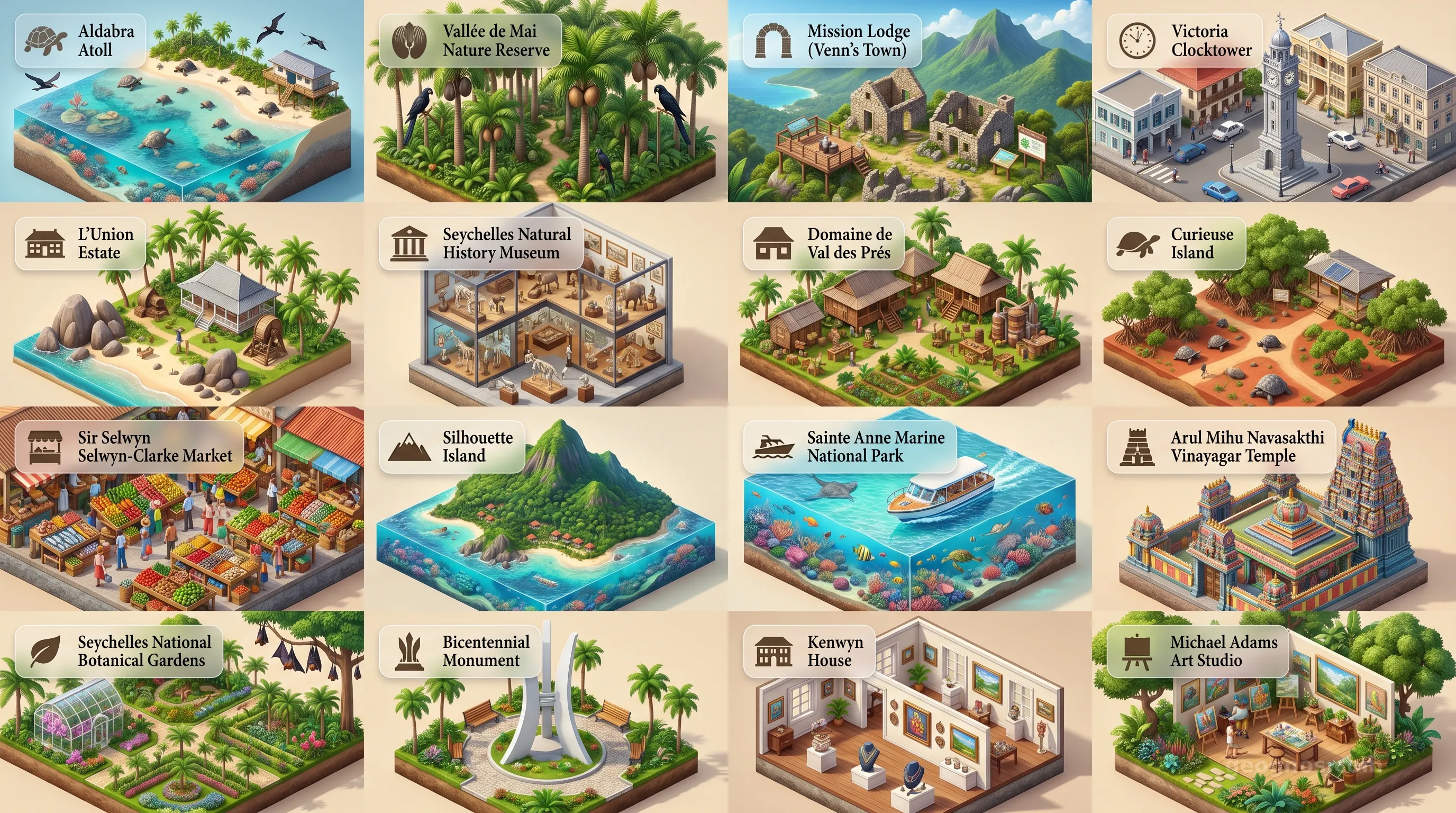
The soul of the Seychelles resides in its aesthetics. There is a specific quality of light here, filtered through dense tropical canopies and reflected off the crystalline waters of the inner granite islands, that has inspired generations of travelers. Every point of interest, from the Vallée de Mai Nature Reserve, a UNESCO World Heritage site, to the sun-bleached shores of Anse Source d'Argent, tells a story of an environment that has been preserved with meticulous care. Visualizing these landscapes is the next best thing to standing before them, and we have curated a collection that highlights these wonders. You can browse the breathtaking visuals through our POI cinematic showcase to get an intimate look at the topography and scenic beauty that defines the nation.
Beyond the scenic allure, the history of these islands is captured in more than just records and academic papers. It is ingrained in the ruins of mission schools, the architecture of colonial ports, and the evolution of the creole language itself. To truly grasp the narrative depth of the islands, one should see the events brought to life. We invite you to view our history cinematic showcase, where top historical events are illustrated through a guided carousel that bridges the gap between historical fact and visual storytelling.
Defining the Seychellois Identity
As a modern nation, the Seychelles holds a significant position in global environmental advocacy. Given its status as a small island developing state, the country faces the unique challenges of climate change and biodiversity protection, yet it has become a leader in blue economy initiatives and marine conservation. By protecting massive swaths of its exclusive economic zone, the nation demonstrates that a deep, historical respect for the environment can translate into sustainable development. This perspective, shaped by the granite mountains and the surrounding deep-sea trenches, makes the Seychelles an essential case study for any student of environmental history or international affairs.
The Seychelles is more than just a destination or a dot on the map. It is a testament to the resilience of life on an isolated fragment of ancient earth. As we look at the country today, we see a bridge between the deep geological past and an optimistic, forward-thinking future. Whether you are conducting research for academic credit, planning a journey, or simply curious about the world around you, the story of these islands is a compelling invitation to look closer at how geography shapes the human spirit.