The Rainbow Threshold: A Continent Reflected
To stand upon the southern tip of the African continent is to witness a world distilled. South Africa is not merely a country, but a geological and cultural confluence, where the restless currents of the Atlantic and Indian Oceans meet, and where the echoes of ancient human origins vibrate against the hum of a modern, multi-layered society. Often referred to as the Rainbow Nation, this vast territory serves as a mirror for the complexities of the human experience, offering a landscape so diverse that it possesses its own micro-climate zones, sprawling deserts, temperate rainforests, and savannahs teeming with life.
For the traveler, the scholar, and the curious student, South Africa represents a unique opportunity to understand how deep-time geography dictates the rhythm of a civilization. From the soaring ramparts of the Drakensberg mountains to the rolling vineyards of the Western Cape, the physical architecture of the nation has compelled its inhabitants to build a culture of profound resilience and creative fusion. To fully appreciate this narrative, one should begin with an in-depth examination of the comprehensive history of South Africa, which outlines the events and movements that shaped the modern state from the cradle of humanity to the present day.
Geological Majesty and the Crucible of Time
The story of South Africa begins billions of years before the arrival of modern institutions. The landscape itself is a prehistoric tapestry. The Karoo basin, for instance, houses fossil records that predate the dinosaurs, while the Witwatersrand remains one of the world's most significant geological formations, its gold-rich reefs having triggered the industrial acceleration of the region. This is a land shaped by fire and pressure, where high-altitude plateaus drop sharply to coastal plains, creating a climatic variety that allows for a staggering density of endemic flora and fauna.
Those wishing to understand the milestones of this progression may find utility in testing their knowledge through the interactive history puzzle of South Africa. This platform invites students and enthusiasts to piece together the sequence of discovery, transition, and evolution that defines the nation, offering a unique pedagogical tool to reinforce the chronology of its development.
A Mosaic of Human Achievement
Beyond the craggy peaks and sweeping plains lies the human soul of the country. South Africa is a cultural crossroads where indigenous traditions—the heritage of the Khoisan, the Zulu, the Xhosa, and the Sotho—intertwine with the legacies of maritime history, global trade, and the arrival of explorers from across the globe. This synthesis has produced a country of eleven official languages and a spirit that expresses itself through jazz, world-renowned literature, culinary innovation, and a tireless pursuit of progress. The artistic life here is a vibrant rebuttal to silence, manifesting in the colorful streets of Bo-Kaap or the sprawling public art installations of Johannesburg.
To gain a visceral understanding of the key moments that elevated this region into the global spotlight, visitors are encouraged to engage with the history cinematic showcase of South Africa. This digital experience utilizes multimedia illustrations and summarized narratives to bring historical inflection points to life, ensuring that the legacy of this land is not just read, but felt by the next generation of global citizens.
The Living Horizon: Experiencing the Geography
There is a fundamental vitality to South Africa that defies a singular description. One day you may be tracing the migratory paths of southern right whales off the coast of Hermanus, and the next, traversing the arid majesty of the Kalahari. The environmental spectrum is perhaps the nation's greatest treasure. It is a country of paradoxes, where highly modernized urban centers operate in tandem with vast protected wilderness areas, such as the Kruger National Park, which serves as a beacon for global conservation efforts.
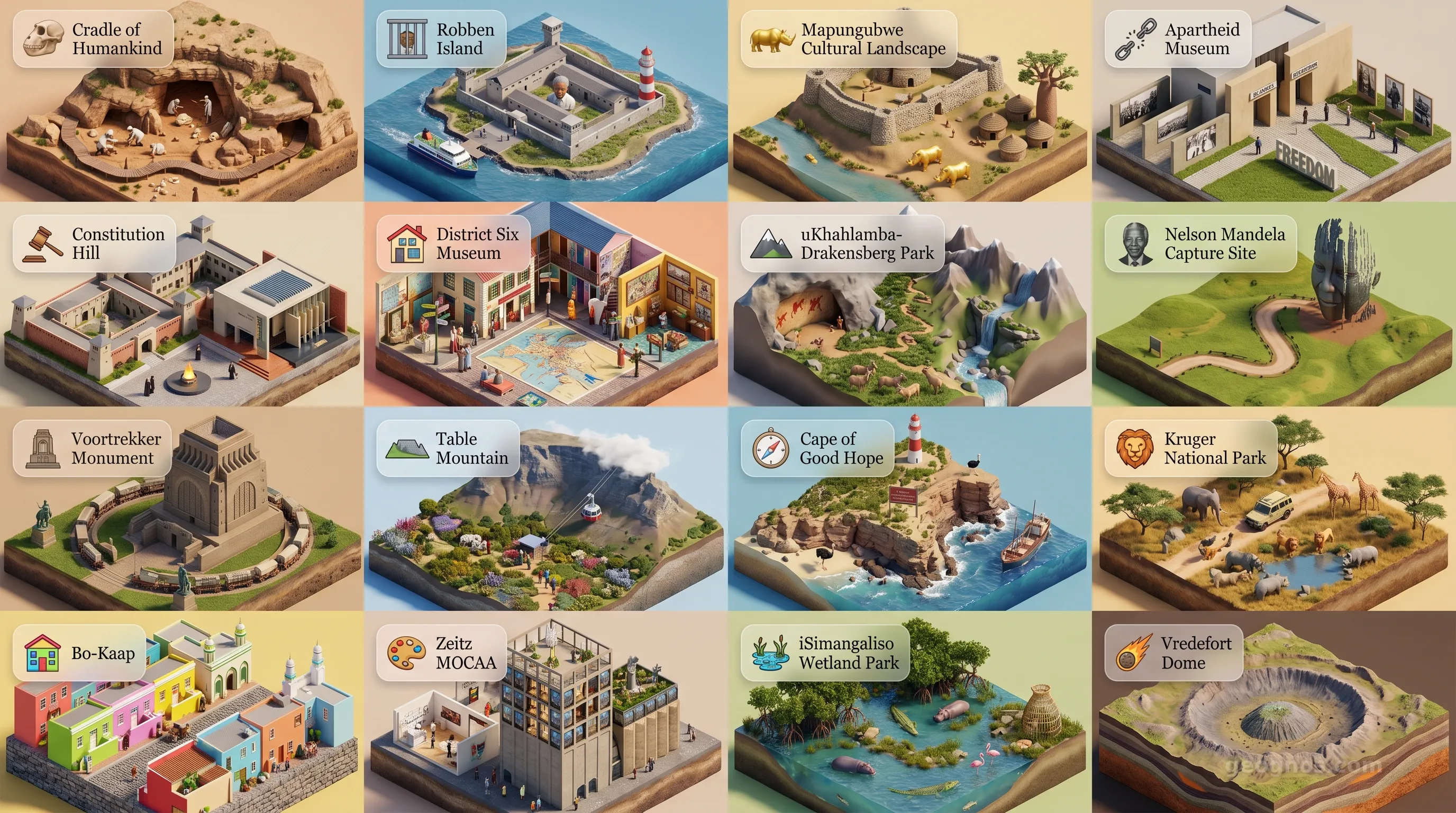
The beauty of this geography is best understood through exposure to its defining markers. We recommend browsing our curated POI cinematic showcase of South Africa. By cycling through these iconic locales—from the jagged silhouette of Table Mountain to the haunting beauty of the Cape of Good Hope—one begins to grasp why South Africa remains a preeminent destination for scientific study and personal exploration. It is a destination that does not just invite visitors to view its features, but demands that they interact with its environmental legacy.
Education and the Future
As GeoGnos seeks to chronicle the world, South Africa stands as a prime example of why geography matters. It is a nation that teaches us about boundaries, about the transition between natural systems and human political order, and about the capacity of a population to thrive within a diverse landscape. Whether you are a student preparing a thesis, an educator building a curriculum, or a traveler mapping a route through the southern hemisphere, remember that South Africa is a study in harmony. It serves as a reminder that regardless of the complexities of our history, the landscape remains our most consistent guide, linking our past, present, and future in a shared journey of discovery.