The Sudd and the Soul of a Nascent Nation
To stand upon the soil of South Sudan is to witness a land defined by the rhythm of the water and the resilience of the spirit. It is the world’s youngest nation, yet its identity is etched into the very bedrock of the African continent. This is a country where the Great Nile, the eternal artery of civilization, pauses to weave a vast, shifting labyrinth known as the Sudd. Here, the landscape is not merely a setting for human history, but an active participant in its unfolding. The vast seasonal wetlands, the sweeping savanna grasslands, and the high-altitude forests of the Imatong Mountains create a mosaic of biodiversity that has sustained diverse ethnic communities for millennia. To understand South Sudan is to embrace a geography that demands adaptation, patience, and an enduring respect for the forces of nature.
For the traveler, the scholar, and the curious student, South Sudan represents an unfolding story. It is a place of profound complexity, where ancient traditions meet the aspirations of a modern state. Our journey into this heart of Africa begins by recognizing that the narrative of this land is not defined solely by its challenges, but by the extraordinary depth of its heritage. When we explore the history of South Sudan, we uncover a saga of migration, cross-cultural exchange, and the indomitable will of the Nilotic peoples who have flourished along the riverbanks for generations. This history is not a static list of dates, but a living experience that we encourage you to engage with through our interactive history puzzle, where the sequence of milestones tells a deeper tale of identity and endurance.
The Living Landscape of the Nile
The Nile serves as both the physical and spiritual anchor of South Sudan. From the southern border where the White Nile enters the plains, the river behaves like an organism. During the wet season, the Sudd acts as a massive sponge, regulating the flow of water and providing a vital sanctuary for migrating wildlife, including the majestic white-eared kob in one of the world's greatest wildlife spectacles. This environmental dynamism has profoundly influenced the societal structure of the Dinka, Nuer, Zande, and Bari peoples, among many others. The seasonal migrations of livestock and the communal management of water resources are foundational to the socio-economic identity of the country.
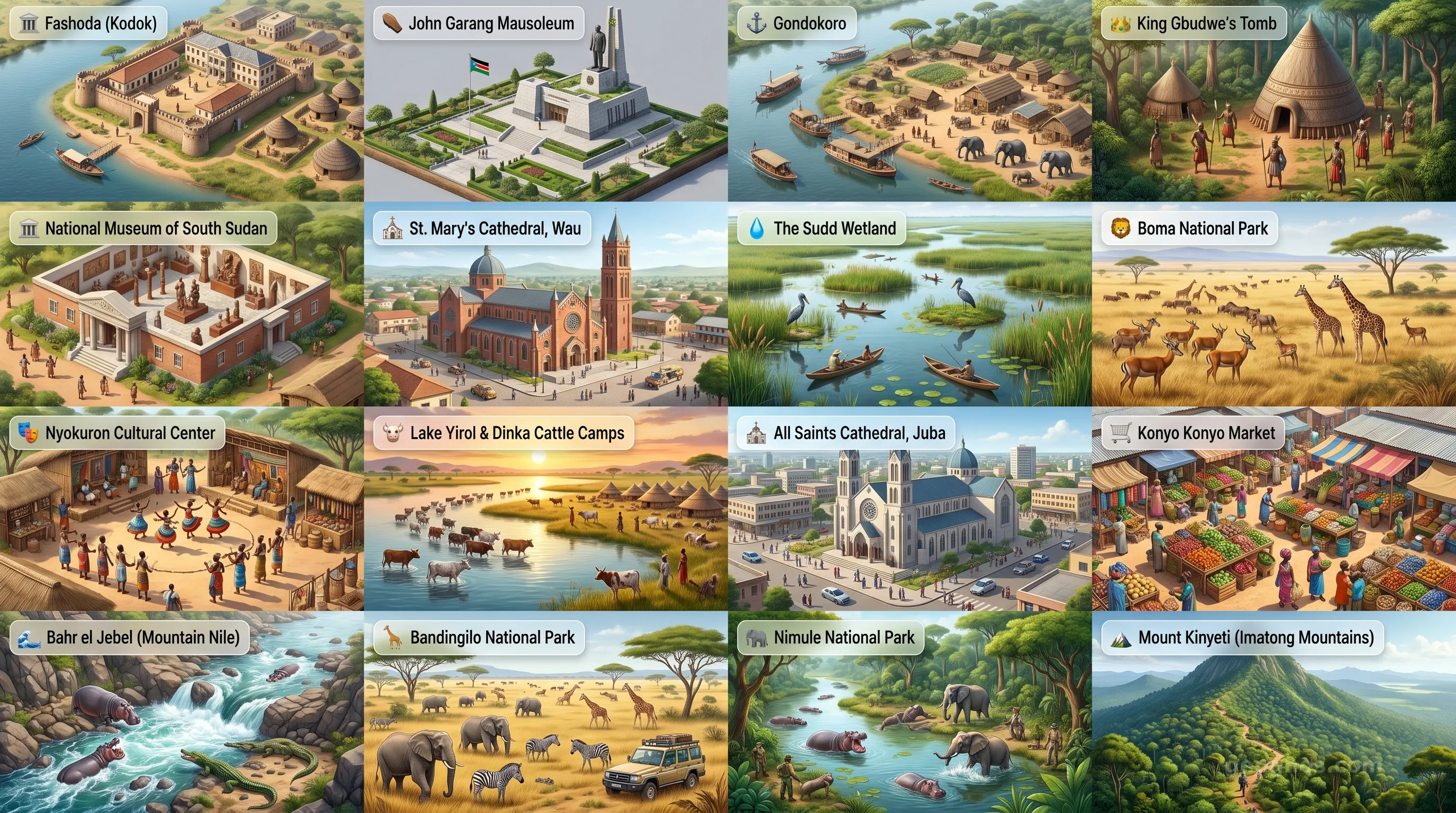
Those who wish to grasp the magnitude of these landscapes may engage with our POI cinematic showcase. Through this interactive tool, you can traverse the breathtaking topography from the floodplains of the north to the rugged heights of the southern border. Visualizing these landmarks provides essential context for understanding how geography dictated settlement patterns and economic development long before the arrival of modern infrastructures.
A Mosaic of Tradition and Modernity
Beyond the water and the savanna, South Sudan is home to a staggering richness of culture. With over 60 indigenous ethnic groups, the nation serves as a crucible of language, art, and custom. The cattle-based economies and the elaborate oral traditions passed down by community elders serve as the social glue of the nation. For educators and students, it is essential to view these cultures as the primary architects of the South Sudanese national identity. As we look toward the future, this cultural density acts as a profound asset, offering a diverse array of perspectives on environmental stewardship and sustainable development.
In our educational efforts, we aim to transform static textbook information into a dynamic appreciation for what has transpired within these borders. To assist with this immersive learning, our history cinematic showcase offers a unique way to witness the evolution of South Sudan through an engaging visual medium. By pairing high-quality illustrations with chronological summaries, we hope to honor the people who have contributed to the birth of this republic and the centuries of movement and growth that preceded it.
Reflecting on the Global Identity of South Sudan
Why does South Sudan matter in the global context of the 21st century? It matters because it is a laboratory of nation-building, environmental harmony, and human perseverance. It reminds us that statehood is a continuous process of reconciliation and building bridges across diverse backgrounds. By studying the climate cycles of the Sudd, the migratory patterns of pastoralist communities, and the legislative efforts of the contemporary government, we gain insights into the nature of governance in fragile but resource-rich ecosystems.
As GeoGnos continues its mission to catalog the unique essence of each nation, South Sudan stands out as a testament to the fact that identity is forged in the fire of shared history and the hope for a stable future. Whether you are conducting research in a classroom, planning an expedition into the heart of Africa, or simply looking to expand your world map, we invite you to use our tools to peel back the layers of this fascinating region. The narrative of South Sudan is still being written, and through our curated content, you are an active part of the global effort to honor and understand this singular corner of the world.
We believe that understanding the nuances of a nation requires more than a casual glance. It requires a willingness to dive into the stories of its people, the challenges of its environment, and the beauty of its landscapes. As we explore the chapters that follow, from its geography and economy to its diverse populations, let us hold in our minds the image of the Nile, ever-flowing and ever-changing, a reflection of the enduring potential of South Sudan itself.