The Horn of Africa’s Eternal Sovereign
To speak of Ethiopia is to speak of a foundational heartbeat of the human experience. Unlike many nations whose borders were drawn in the halls of foreign empires, Ethiopia exists as a self-determined geographic and cultural fortress. It is a land of vertical extremes, where the earth pushes toward the heavens in jagged volcanic peaks and falls away into deep, sun-drenched valleys. Ethiopia is not merely a country in the contemporary sense. It is an enduring witness to the passage of time, an ancient soul that has carved its own narrative directly into the basalt of the Great Rift Valley.
For the traveler or the scholar, Ethiopia offers a rare kind of discovery. Here, history is not buried beneath layers of static dust. It lives in the liturgical chants of the Tewahedo Church, the distinct flavor of endemic coffee ceremonies, and the intricate stone-carved churches that remain as functional today as they were when they were chiseled from solid rock centuries ago. To understand the trajectory of this resilient nation, one should delve into the comprehensive history of Ethiopia, which traces the evolution from the ancient Kingdom of D’mt and the powerful Aksumite Empire to the modern sovereign state that stood as a beacon of independence for the African continent.
A Landscape of Verticality and Contrast
Ethiopia’s geography is its destiny. The country is dominated by the Ethiopian Highlands, a massive central plateau split by the jagged depression of the Great Rift Valley. This environment dictated how civilizations clustered, how trade routes were established, and why this region remained so distinct from its neighbors. In the north, the Simien Mountains rise like gargantuan fortresses, their sheer cliffs offering home to unique endemic species such as the Gelada baboon. Moving toward the south, the terrain shifts into expansive savannahs and lush, low-lying river valleys, creating a biodiversity hotspot that has sustained human life for millions of years.
The interaction between this complex geography and the people who navigated it is best understood through time. We invite our students and history buffs to challenge their knowledge of the local timeline through our interactive Ethiopian historical chronology puzzle. Mastering these milestones offers a clearer perspective on how the physical challenges of mountain life shaped a society defined by extreme tenacity, pride, and architectural ingenuity.
The Living Museum of Ancient Heritage
One cannot truly appreciate Ethiopia without acknowledging its role as a cross-continental nexus. Located at the intersection of Africa, the Middle East, and the Indian Ocean trade networks, Ethiopia became a repository for ideas, scripts, and religious traditions. It possesses the only indigenous script in sub-Saharan Africa, Ge'ez, and maintains a calendar system that keeps it seven years behind the Gregorian standard, a subtle reminder that time here follows a rhythm unique to the Ethiopian soil.
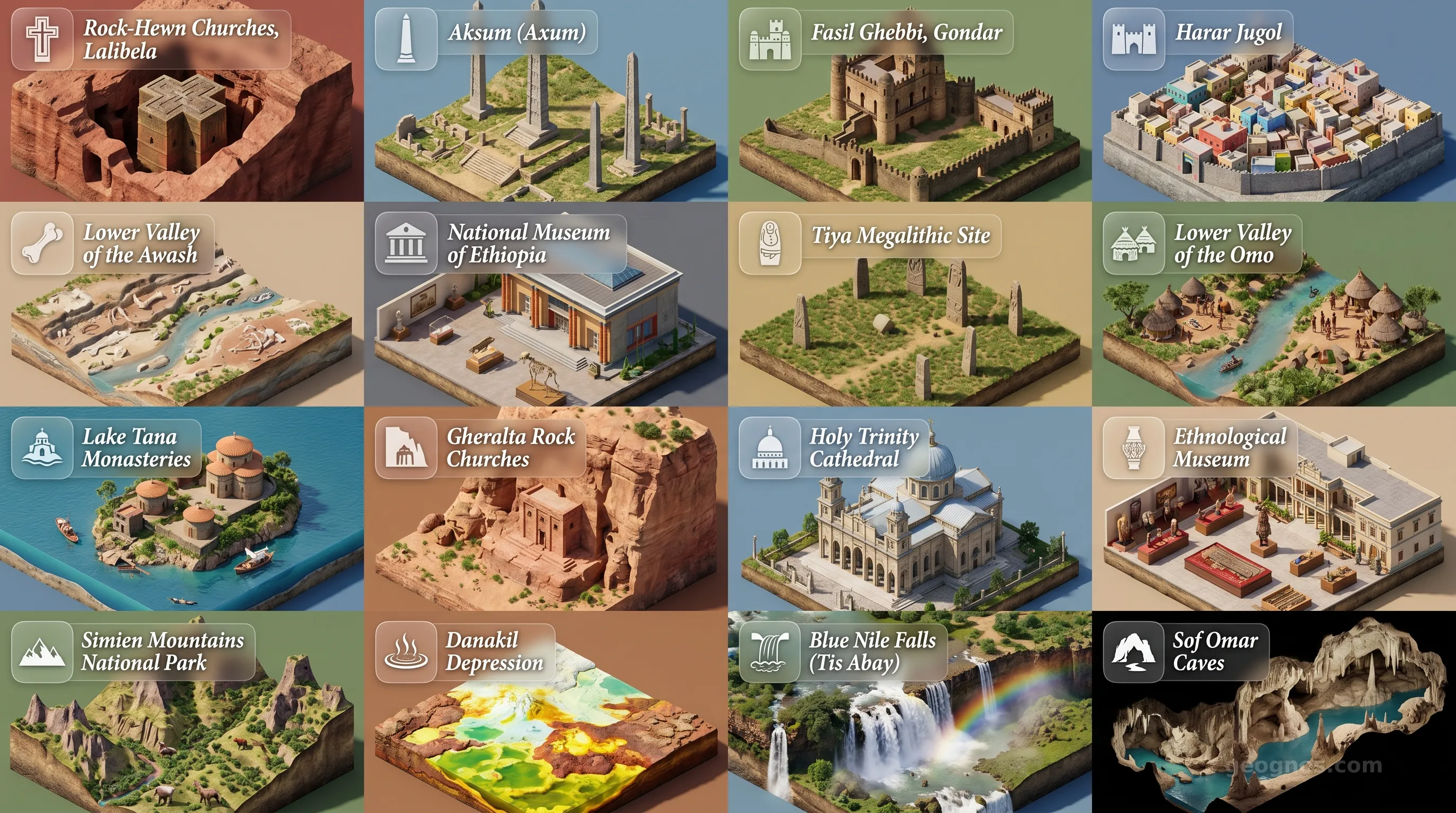
The architectural marvels of the country are scattered across this rugged terrain like hidden jewels. From the towering stelae of Aksum to the underground basilicas of Lalibela, the physical evidence of this heritage is breathtaking. For a more immersive experience, you may browse our history cinematic showcase, where visual artistry meets scholarship to illuminate the grand sweep of events that define the nation. Furthermore, for those planning a journey through these high-altitude landscapes, our POI cinematic showcase provides a gallery of the most spectacular destinations that every traveler should keep on their map.
An Enduring Legacy of Intellectual Depth
What defines the "soul" of Ethiopia is its unbroken connection to its own heritage. While other civilizations saw their pasts erased or absorbed, Ethiopia maintained a continuity that remains visible in its language, its social structures, and its culinary traditions. The national spirit is rooted in a philosophy of togetherness and dignity. The traditional coffee ceremony, a ritualized social interaction of grace and patience, is the perfect metaphor for the Ethiopian approach to life. It is slow, it is meaningful, and it is built on the strength of community bonds.
As GeoGnos continues to explore this nation, we focus on the interplay between the ancient and the modern. Whether through the lens of geological formations or the socio-economic evolution of its people, Ethiopia serves as an essential subject for anyone seeking to understand the global story. It is a nation that asks us to look up at its mountain peaks, to look down into its fertile basins, and to listen carefully to a history that is still being written by a people proud of their role as the architects of their own destiny. Through our atlas, we hope to provide the tools for you to navigate, appreciate, and study this profound landscape with the respect and curiosity it so richly deserves.