The Cradle of Humanity and the Horizon of the Future
To look upon Kenya is to gaze into the very origins of the human story. Stretching from the sun-drenched beaches of the Indian Ocean to the rugged, snow-capped spires of Mount Kenya, this nation serves as a living library of our shared past and a vibrant laboratory for our collective future. Kenya is more than a geographic entity; it is an epic poem written in the red earth of the Great Rift Valley, echoing with the rhythmic life force of the savanna and the bustling, innovative spirit of its urban centers.
For many, Kenya represents the quintessential African landscape. Yet, beneath the postcard imagery of acacia trees and sprawling golden plains lies a complex, layered society that has mastered the art of convergence. Here, ancient nomadic traditions find resonance within the glass towers of Nairobi. Ancient Swahili trading ports, once the endpoints of trans-oceanic spice routes, now pulse with a modern, cosmopolitan energy. Understanding the gravity of this nation requires a dive into the deep past, which you can explore in our comprehensive history of Kenya, a resource designed to illuminate the pivotal moments that shaped the heart of East Africa.
The Geography of Contrast
Kenya is defined by the Great Rift Valley, a colossal tectonic scar that bisects the nation and creates an astonishing array of microclimates and habitats. From the arid desert plains of the north, which guard the secrets of Turkana, to the fertile, rolling tea estates of the central highlands, the sheer diversity of the terrain is breathtaking. This is a landscape of extremes. It is a place where high-altitude peaks dominate the sky, feeding the river systems that sustain one of the world's most spectacular wildlife corridors.
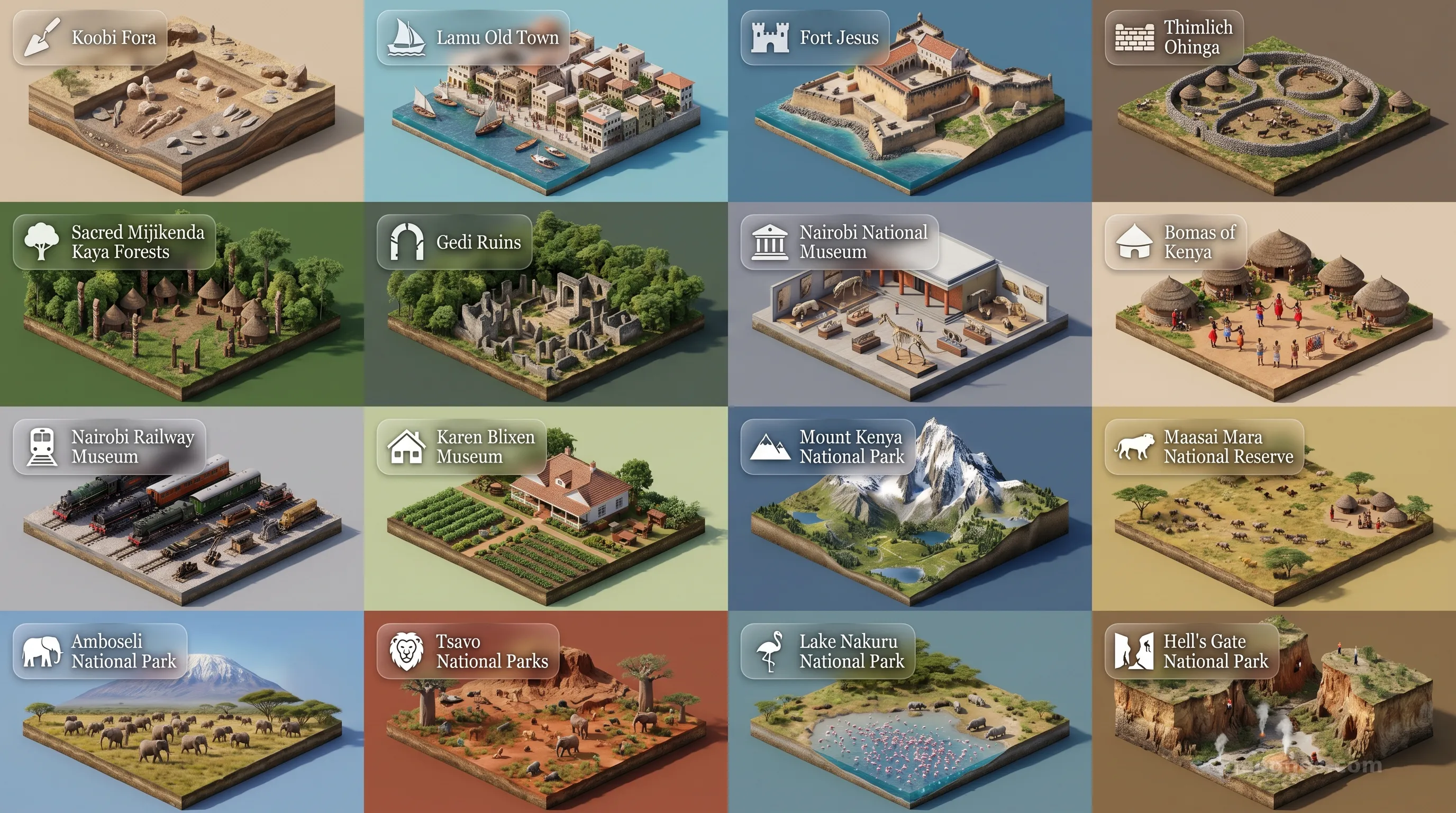
To appreciate how the unique environment creates such varied topographies, it is helpful to visualize these sites in motion. We invite you to engage with our POI cinematic showcase, which offers a vivid, visual tour of these majestic points of interest. By seeing these landmarks up close, one begins to understand why this specific geography has supported human life for millions of years, acting as a crossroads for migration, trade, and cultural evolution.
A Heritage of Resilience and Evolution
The soul of Kenya is best understood through its resilience. Throughout the centuries, the land has witnessed the rise of complex city-states on the coast, the movement of diverse Nilotic, Bantu, and Cushitic peoples across the interior, and the profound impacts of colonial shifts. Every event has left an indelible mark on the national psyche, contributing to a modern identity that is both deeply rooted in ancestral customs and dynamically oriented toward globalization.
For students and enthusiasts who wish to test their understanding of how these events unfolded across time, we recommend the history puzzle. This interactive challenge serves as an excellent pedagogical tool for mastering the timeline of East African development, rewarding your inquiry into the past with milestones and badges that reflect your growing expertise in Kenyan studies.
Chronicles of a Nation
One cannot discuss the modern identity of Kenya without acknowledging the profound importance of historical preservation. The narrative of the nation is one of steady transition. Whether one considers the archaeological discoveries in the cradle of humankind or the independence movements of the mid-twentieth century, the history of this land is an active participant in how its citizens view the world today. We have curated a specialized history cinematic showcase to bring these formative moments to life, allowing users to move through time via an immersive visual platform that bridges the gap between academic theory and human reality.
Living in the Harmony of the Wild
Perhaps the most defining feature of Kenya is the relationship between its people and the natural world. Conservation is not merely a government policy in Kenya; it is a fundamental aspect of the cultural heritage. From the Maasai and Samburu communities who have coexisted with apex predators for generations to the scientific innovators working to protect delicate ecosystems from climate change, Kenya represents a global model for environmental stewardship.
As you delve further into our Atlas, you will find that the story of Kenya is not fixed. It is a living, breathing discourse on adaptation. As we move beyond this introduction, we encourage you to examine the structural layers of the nation, from its robust parliamentary democracy and economic indicators to the intricate networks of transportation and communication that connect remote villages to the bustling international hubs of Nairobi and Mombasa. Every facet of Kenyan life tells a part of the greater story: a story of a people determined to nurture the cradle of humanity while sprinting toward the possibilities of a new millennium.