The Golden Gateway: Understanding the Soul of Ghana
To step into Ghana is to step into the beating heart of West Africa. Known as the Gold Coast in a bygone era, the nation is far more than its storied mineral wealth. It is a land defined by a profound capacity for resilience, a vibrant tapestry of tradition that refuses to fade in the face of modernity, and a geography that has served as a central crossroads for global migration, trade, and cultural synthesis for centuries. Positioned along the Gulf of Guinea and nestled between the French-speaking nations of Togo, Côte d'Ivoire, and Burkina Faso, Ghana occupies a unique space that serves as both a gateway to the African continent and a bridge between its deep ancestral roots and an ambitious, forward-looking future.
The spirit of Ghana is etched into the very soil, from the verdant, high-canopy rainforests of the south to the stark, sun-drenched savannahs of the north. This is not merely a country on a map. It is a living, breathing history lesson where colonial-era forts stand defiantly against the crashing Atlantic waves, holding within their walls the heavy memories of a global tragedy, even as the nearby bustling markets demonstrate the unstoppable vitality and entrepreneurial zeal of the Ghanaian people today. Understanding how these disparate elements have harmonized over time requires a careful examination of its past. You can begin that journey as you explore the comprehensive history of Ghana, which illuminates the evolution from the powerful Asante Empire to the first nation in sub-Saharan Africa to achieve independence from colonial rule.
A Convergence of Time and Tradition
Geography in Ghana has never been passive. The Volta River, one of the world's largest man-made reservoirs, shapes the lives of millions and serves as a literal lifesaver for agricultural and energy production. The southern coastline, where the lush lowlands give way to tropical beaches, has attracted seafaring visitors for millennia. This attraction—sometimes harmonious, often turbulent—has fostered a culture that is inherently welcoming and cosmopolitan. Ghanaian hospitality, or "akwaaba," is not just a polite gesture but a cornerstone of the national identity, reflecting a society that places immense value on communal bonds, education, and collective progress.
For those looking to engage deeply with the complex timelines that have forged this identity, there is no better way to master the material than through an active, gamified lens. Students and history enthusiasts can test their grasp of the nation’s formative years when they play our interactive history puzzle, a challenging chronology that puts your knowledge of Ghana's transformative political and social milestones to the test.
The Sensory Legacy: From Castles to Culture
Ghana presents itself to the traveler as a kaleidoscope of sensory experiences. It is in the intricate patterns of Kente cloth, where every color and design conveys a specific meaning or historical reference. It is in the rhythmic percussion of the Djembe and the lively sounds of Highlife music echoing through the streets of Accra. It is in the stoic stone walls of Cape Coast and Elmina, structures that demand contemplation and honor. To see these landmarks is to witness the architectural manifestation of human tenacity.
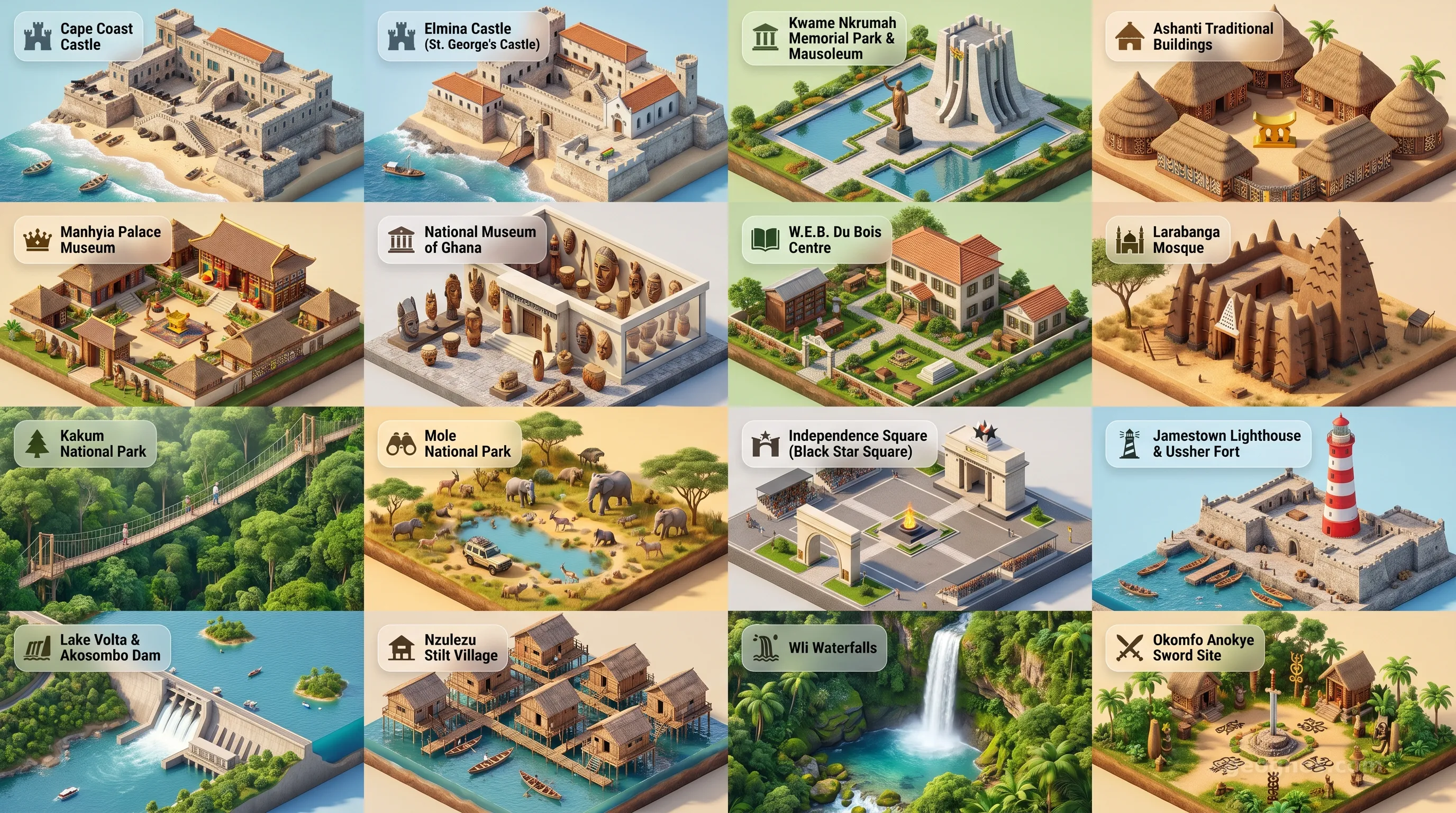
For students and travelers who wish to immerse themselves in the aesthetic journey of the nation without stepping on a plane, our multimedia resources offer an immediate bridge. You can visually navigate through these powerful cultural landmarks when you view our curated history cinematic showcase. This collection provides high-fidelity illustrations of seminal historical events, contextualizing the struggle and triumph that defines the Ghanaian character. Furthermore, for a deeper understanding of the geographic and cultural beauty that awaits, you may explore our POI cinematic showcase, which maps the must-see locales—from the sacred groves to the vibrant modern architecture—that anchor Ghana's modern-day identity.
A Future Rooted in Resilience
The contemporary narrative of Ghana is one of stability, innovation, and an unwavering commitment to democratic principles. In a world that is increasingly fragmented, Ghana stands out as a beacon of diplomatic balance and economic growth. This is a country that understands the value of its own narrative. Its education system, burgeoning arts scene, and dedication to environmental sustainability serve as evidence that the nation is looking firmly ahead, using its history not as a tether, but as a foundation.
By studying Ghana, one does not merely learn about a single West African nation. One gains insight into the mechanisms of development, the power of cultural preservation, and the necessity of maintaining one's heritage in an era of globalization. Whether you are a student piecing together the timeline of West African liberation or a traveler seeking a deeper connection to the human experience, Ghana offers a curriculum that is both challenging and infinitely rewarding. As you proceed through our Atlas pages to examine the diorama, the political landscape, and the environmental metrics, remember that you are exploring a land of pioneers, a people of profound intellect, and a geography that continues to write its own destiny.