The Verdant Gateway: Understanding the Soul of Côte d’Ivoire
To travel through Côte d’Ivoire is to traverse a landscape where the rhythm of the Atlantic tides meets the whispering expanse of the West African interior. Known globally as the world’s leading producer of cocoa, this nation is often reduced to the simple economic output of its soil. Yet, beneath the canopy of its lush rainforests and beyond the neon pulse of its modern architectural marvels, lies a cultural tapestry woven with the threads of over sixty distinct ethnic groups. Côte d’Ivoire is a country that thrives on the harmonious intersection of ancient traditions and a rapidly accelerating modernity, serving as an anchor of stability and a beacon of cultural fusion in the Gulf of Guinea.
The geography of the nation functions as a physical map of its spirit. From the mangrove-lined lagoons of the south to the rolling savannahs of the north, the land demands adaptability. It is a place where the infrastructure of history—the scars and triumphs of the past—is continuously reshaped by the vibrancy of the present. To understand this nation, one must appreciate its layered narrative, a story that students and travelers can uncover by reading our comprehensive history essay of Côte d’Ivoire, which details the socio-political evolution of the country from its colonial encounters to its role as a regional economic powerhouse.
A Mosaic of Tradition and Progress
What defines the "Ivorian experience" is the concept of akwaaba, or hospitality. Whether you are walking the streets of the economic capital, Abidjan—frequently called the Manhattan of Africa for its shimmering skyline—or visiting a traditional village in the deep interior, the warmth of the people is the constant, driving force of the country’s character. This sense of identity is not stagnant. It is a fluid, evolving entity that encourages a deeper engagement with the timelines of local legends and national breakthroughs. For those looking to test their knowledge of the milestones that brought the nation to where it stands today, we invite you to solve the history puzzle of Côte d’Ivoire, an interactive journey designed to sharpen your grasp on the chronology of West African development.
The architectural shift in Abidjan alone represents a daring ambition to blend French colonial influence with modernist African sensibilities. Yet, the heart of the country is not merely in its concrete canyons. It is found in the masks of the Dan people, the rhythmic storytelling of the griots, and the distinct flavors of Ivorian cuisine, particularly the ubiquity of alloco and attiéké. These elements represent a profound connection to the land. To visualize the grandeur of these traditions and the pivotal moments of national progress, educators and students may explore our history cinematic showcase, which presents the nation's journey through high-resolution illustrations and curated narrative archives.
The Geographical Crossroads
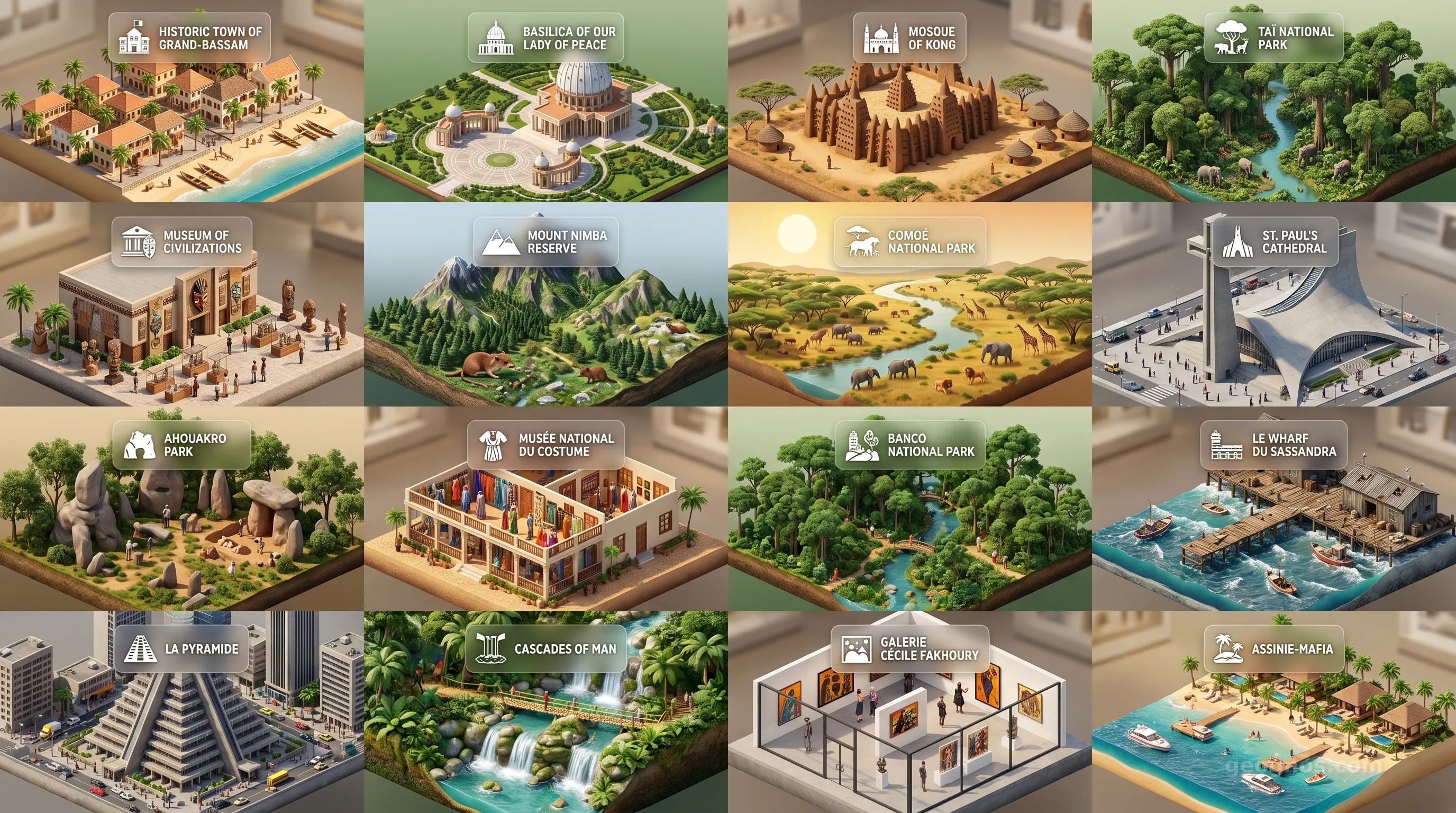
The physical diversity of Côte d’Ivoire is one of its greatest treasures. To the west, the Nimba Mountains offer a rugged, elevated contrast to the coastal lowlands, providing habitats for unique species of flora and fauna. These regions act as the lungs of the country, regulating its tropical climate and sustaining the dense rainforests that have played such a critical role in its history. This biological wealth is matched by the country’s significant sites, ranging from the historic town of Grand-Bassam to the breathtaking architectural achievement of the Basilica of Our Lady of Peace in Yamoussoukro.
As you plan your engagement with this multifaceted nation, whether for academic research or personal discovery, it is essential to appreciate the locations that define its aesthetic and historical significance. We invite you to view our POI cinematic showcase to see the country's most iconic landscapes and structures brought to life. These images provide a visual portal into the environments that have shaped Ivorian life, offering a deeper understanding of why the nation continues to be a central pillar of West African development and cultural richness.
The essence of Côte d’Ivoire is ultimately defined by its resilience. It is a nation that has balanced the complexities of its natural environment with the demands of a globalized economy. It remains a place where the old and the new coexist in a constant, pulsating dialogue. Whether you are drawn by the scientific curiosity of its geography, the academic depth of its history, or the sheer aesthetic wonder of its coastal reaches, Côte d’Ivoire stands as a testament to the enduring human spirit and the importance of preserving the distinct character of the African landscape. As you proceed through the subsequent sections of this atlas, keep in mind that you are studying a nation that is both a guardian of ancient paths and a trailblazer for the continent’s future.