The Cradle of Earth and the Swahili Heartbeat
To stand upon the soil of Tanzania is to stand at a profound intersection of time and space. It is a land where the human story finds its most ancient echoes and where the pulse of the African continent beats with rhythmic, untamed vitality. Spanning from the shimmering turquoise horizons of the Indian Ocean to the jagged, volcanic heights of the Great Rift Valley, Tanzania serves as a grand theater for the natural world. It is not merely a country; it is an experience of extremes, where the golden plains of the Serengeti collide with the mystical, spice-scented alleyways of Zanzibar, and where the eternal snows of Kilimanjaro look down upon a landscape that has nourished humanity for millions of years.
Tanzania’s identity is forged in the forge of the Great Rift Valley, a colossal geological tear that has shaped not only the contours of the land but the very evolution of our species. To understand how these physical forces directed the flow of civilizations, it is helpful to explore the history of Tanzania, where centuries of trade, migration, and cultural blending have created a tapestry as complex as the geography itself. From the influence of the Oman Sultans to the remnants of German and British colonial architecture, the nation is a living museum of human perseverance.
A Crossroad of Cultures and Landscapes
While the internal highlands offer a temperate climate conducive to agriculture and wildlife, the coastline serves as a window to the world. For over a millennium, the Swahili Coast has functioned as a vital maritime gateway, linking the interior of Africa to the markets of Arabia, India, and China. This unique blend of Bantu heritage and Islamic influence has birthed a culture of hospitality known as karibu, a word that permeates every encounter in this nation. It is a culture built on the philosophy of Ujamaa, emphasizing unity and community, which remains the foundational pillar of the Tanzanian social fabric.
For those looking to engage with this past in a more dynamic way, you may find that our history puzzle provides an excellent challenge. By arranging pivotal historical markers in their correct chronological order, students and history enthusiasts can test their knowledge while uncovering the nuanced sequence of events that brought Tanzania into the modern era. Those who prefer a more sensory engagement with the past will appreciate the history cinematic showcase, which weaves together archival illustrations and vivid summaries to bring long-lost eras to life in a series of immersive, high-definition snapshots.
The Majestic Beauty of the Tanzanian Wilderness
Geographically, Tanzania is perhaps best defined by its dramatic scale. It houses the three great lakes of the African continent: Victoria to the north, Tanganyika to the west, and Nyasa to the south. Each lake possesses its own distinct ecosystem and socioeconomic rhythm, serving as the lifeblood for millions of citizens. Between these watery giants lie the sprawling savanna ecosystems of the Selous and the Serengeti, where the cycle of the Great Migration continues uninterrupted by the passage of modern time.
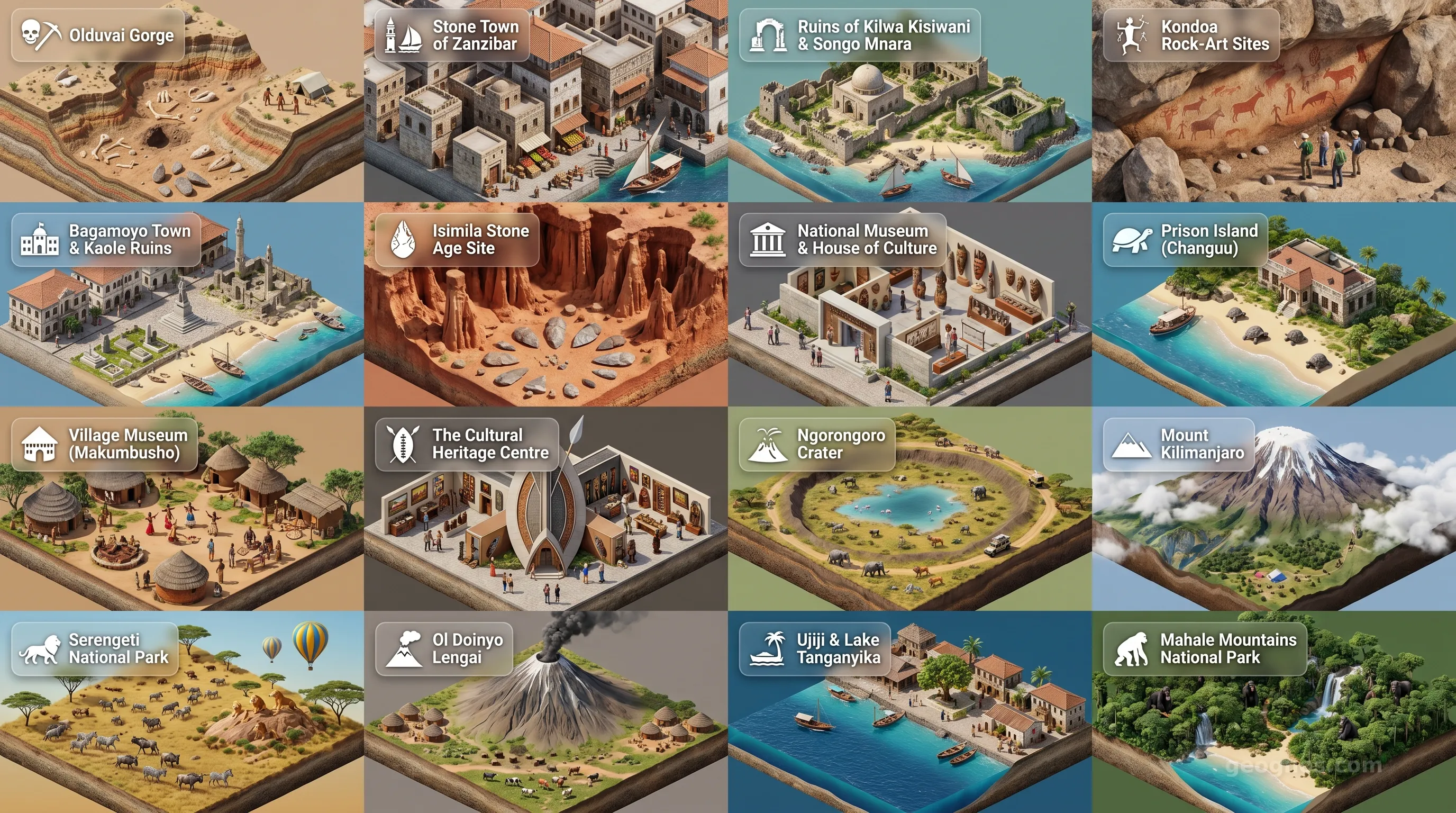
It is in these untamed places that the true magnitude of Tanzania’s ecological value is found. To truly appreciate the diverse splendor of the nation’s natural monuments and architectural marvels, we invite you to view our POI cinematic showcase. This visual journey traverses the snow-capped peak of Kilimanjaro, the archaeological marvels of Olduvai Gorge, and the historic Stone Town of Zanzibar, providing a comprehensive look at the wonders that make this nation a crown jewel of East Africa.
Tanzania in the Global Imagination
Today, Tanzania stands as a stable and optimistic force within East Africa, balancing the preservation of its vast natural resources with the developmental needs of a burgeoning, youthful population. Its approach to nationhood—characterized by peace, diplomatic engagement, and an enduring respect for ethnic diversity—serves as a model for many. Whether it is the rhythmic beat of Bongo Flava music echoing through the streets of Dar es Salaam, or the silent, breathtaking patience of a lion stalking across the Ngorongoro Crater, the country captures the imagination of every visitor.
As you explore our atlas entries, keep in mind that Tanzania is not a static object of study. It is an evolving, breathing narrative. It invites students to contemplate the origins of their own species at Olduvai, encourages travelers to lose themselves in the fragrance of clove and vanilla in Zanzibar, and asks us all to recognize the necessity of protecting the planet's most delicate and beautiful ecosystems. We hope the following sections regarding governance, economic vitality, and environmental statistics provide a firm foundation for your understanding of this incredible nation, allowing you to appreciate both the grandeur of its landscapes and the strength of its spirit.